Grains de riz · Reiskornband · 1940s to today
Beads of Rice
The beads-of-rice bracelet by maker: Gay Frères, the Omega-signed references, JB Champion, NSA, Expandro and the catalogue brands of the 1950s to 1970s, followed by the bracelets you can buy new today.
Origins
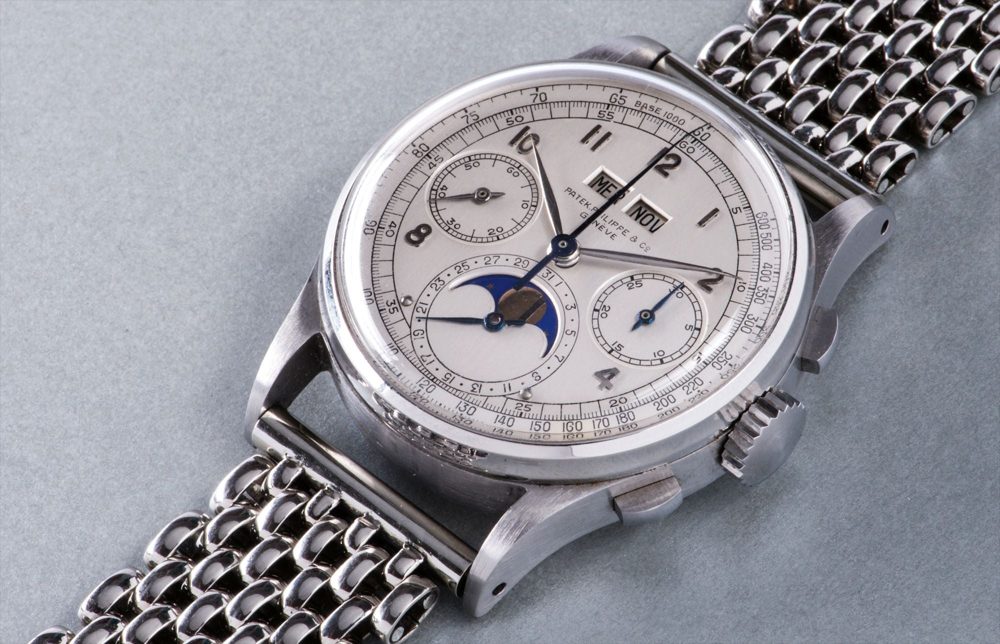
The beads-of-rice bracelet is credited to Gay Frères of Geneva, in the early 1940s. Every account says so, and all of them are secondary: no patent, catalogue page or period advertisement for the first one has surfaced. The watches most often cited are steel Patek Philippe chronographs made between 1941 and 1943, refs 530, 1463 and 1518, and Rolex Bubblebacks in steel and pink gold. The bracelet on the famous steel 1518 carries a 1959 clasp stamp, so it is not proof of a 1943 date.
The name describes the links. Rows of small rounded pieces, convex on top, lie side by side like grains of rice, usually between two wider outer rows. French sources say grains de riz or perles de riz, German sellers Reiskornband. Heuer collectors shorten it to grain and speak of double-grain and single-grain bracelets.
Gay Frères began as a chain maker for pocket watches and was producing bracelets on an industrial scale by the 1940s. One account puts its output in 1942 at about 1,000 kg of stainless steel a month and 700 bracelets a day. The first beads-of-rice bracelets end in a plain tube that the spring bar passes through. Fitted end links that hug the case arrived on Rolex bracelets in 1954, and curved, numbered end links followed on beads of rice.
Omega made the style common. Its own signed bracelets appear from the mid 1950s and run into the 1970s in two families that collectors call 5-row and 7-row. In the United States most Omegas were sold on straps and the jeweller added a bracelet, often made locally by JB Champion. That firm's sliding-clasp bracelet of about 1954 to 1963 is one of the earliest Omega-signed beads of rice.
In the 1960s Gay Frères supplied signed versions to Heuer, IWC, Eterna and Universal Genève, each with letter-coded end links and a clasp dated by quarter and year. The West German firm Kiefer built the spring-loaded Expandro that the Doxa Sub wore from its launch in 1967. In Geneva, Novavit sold bead-pattern bracelets under the NSA mark. American catalogue makers such as Speidel, Gemex, Hadley and Kestenmade put the pattern on expansion bands sold through jewellers.
The style faded around 1980. Doxa says it replaced its beads of rice with a three-link bracelet in the early 1980s, JB Champion stopped trading in the mid 1980s, Novavit closed in 1995 and Rolex bought Gay Frères in 1998.
It came back through small makers. Uncle Seiko's first bracelet, in 2016, was a beads of rice for the Longines Legend Diver, and the Forstner name was revived in 2019. Watch brands followed: Doxa, Baltic and Nivada Grenchen sell one as an accessory, Longines fits one at the factory, and TAG Heuer returned it to the Carrera in 2025. Since 2024 a US dealer has also been selling new bracelets under the Gay Frères name.
At a glance
Each family lists how it is built, how it is marked and what it fits.
One bar per family, using the dates on clasps and in listings. Bars are approximate; several families overlap for a decade or more. Click a row to jump to its bracelets.
Geneva in the early 1940s, most makers gone by the 1980s, revived from 2016
Makers and bracelets
Photos come from the dealer, forum and maker pages listed under Sources, credited where the source is known. Eight are image-search results whose origin I could not confirm; their captions say search photo. Four rows have no photo yet. Click a photo to enlarge it. Each shows one example, so details vary. If a photograph is yours and you want it credited or removed, write to me.
Gay Frères, straight ends
Rows of small convex links between plain tube ends that the spring bar passes through. Documented with 5 rows, 7 oversized rows, 3 rows and mixed bead sizes. One writer describes the centre links as folded loops like those of a Jubilee; one owner reports solid links with no pins. Steel, yellow and pink gold, platinum, and steel with pink gold. Folding clasp. Widths recorded: 13, 16, 17, 18, 19 and 20 mm. Dealer examples run 5.1 to 6.7 in, so many are short for a modern wrist.
Markings. G F with a chamois head between the letters, plus Brevete, Steelinox and Swiss Made on steel clasps, often with a quarter and year such as 2 51 or 4-55. Gold bracelets are stamped GF with a date. Rolex- and Patek-signed clasps exist; two opposing P on the outer clasp mark a Patek bracelet. Many early clasps are undated, and the tube ends carry no stamp.
Gay Frères, signed with coded end links
The same maker's 1960s production for watch brands: curved end links stamped with a brand letter and a model letter, a tapering bracelet (about 20 mm at the lugs and 16 mm at the clasp on Heuer) and a signed folding clasp. Heuer bracelets come in two types. Double grain has paired grains on the linking links and wider outer links. Single grain, from 1969, has one grain and a fliplock clasp. End links measure about 0.7 mm under the nominal lug width.
Markings. G F with the chamois logo, Brevete, Steelinox, Swiss Made and a quarter and year inside the clasp. The watch brand's name or logo is on the clasp cover. End-link codes start with H for Heuer, I for IWC, U for Universal Genève and K for Eterna KonTiki.
Omega-signed
Two families. The rounded type (1502, 1036, 8220 and today's 3010) is called 5-row by most collectors. The flatter, more angular type (1503, 1037, 1068, 8270) is called 7-row. Others count the two wide outer rows as well and call the same bracelets 7-row and 9-row. Centre links are folded loops, open underneath. The removable links near the clasp are held by small spring pins. 18 mm at the lugs with a 16 mm clasp; 17 and 19 mm versions exist. Typical length 15.5 to 17.5 cm.
Markings. Ω OMEGA, the bracelet reference and Stainless Steel inside the clasp, with a raised Ω on the cover. No 12 in a circle is the clasp type, not the reference. Gold-plated bracelets add Gold Plated 20 Microns. End links are numbered 11, 12, 511 or 512 on the 5-row and 70 or 570 on the 7-row. US-made bracelets read Omega Made in U.S.A., sometimes with JB, and have unnumbered end links. No source names the Swiss maker.
JB Champion
Jacoby-Bender's bracelet brand, made in the United States and supplied to the American distributors of Swiss brands. One listing shows C-shaped beads clipped over fixed pins, which is a folded construction. Deployment clasp. Men's 18 mm, ladies' 13 and 16 mm. Zodiac versions have 17.2 to 17.5 mm curved ends.
Markings. JB in a triangle with USA, or JB Champion and Stainless Steel. On brand bracelets: Omega Made in U.S.A., Zodiac with or without Champion USA, Rolex Stainless Steel U.S.A. Gold-filled pieces read 1/20 10 KT gold filled top shells, stainless steel back. Jacoby-Bender bought Forstner in 1963 and stopped trading in the mid 1980s.
NSA (Novavit, Geneva)
Novavit S.A. made adjustable bracelets in Geneva from 1947 to 1995. They have a base length of 6.25 in, every link removable with a nail-type pin, and a spring-loaded clasp that gives a few millimetres. Two bead patterns appear in a dealer's list of 25 new-old-stock styles. No source describes the row count or says whether the links are folded.
Markings. NSA Swiss Made Steel Inox Pat. on the clasp, with the NSA triangle-in-circle logo registered in 1948. No date code and no end-link code were found. A modern brand that also trades as NSA sells a new bracelet; it is not Novavit.
Expandro for Doxa
A beads-of-rice bracelet with spring-loaded expansion and a ratcheting clasp that hides an extra link for wearing over a wetsuit. Each half has two screwed links and one sprung link. Links are riveted and 16 mm wide, with flared 20 mm end links. There are three versions and four clasps: Doxa Sub 300 on the earliest, two with the Synchron logo, with and without a circle, and one that reads only Doxa. The clasp adjusts by a push button and ratchet. Fits to about 8 in when expanded.
Markings. The earliest clasps carry no Expandro mark, only Stainless Steel inside. Later ones are engraved with the Expandro name and German patent 2111820. End links are stamped 7720-4 on the Sub 300 of 1967 and 7720-10 on the Sub 300T. Doxa and Fratello both name the West German firm Kiefer-Cadman as the maker, and a 1957 brochure from Kiefer K.G. of Pforzheim advertises Expandro bands. Kiefer also sold unsigned Expandro bracelets under its own name.
Other European makers
Generic bracelets sold through watchmakers and jewellers. The two documented here have straight ends or a taper, brushed outer links and polished grains. Forum members also name Montal, Monvil and Wandayke as makers of straight-end beads of rice, without details.
Markings. The maker's name or logo on the clasp, with Stainless Steel on the inner blade. I found no date codes.
American catalogue makers
Bands sold through jewellers as accessories. Most are expansion bands with a rice-bead surface, not pinned multi-row bracelets in the Gay Frères sense. Deployment-clasp versions are listed for Hadley, Hope and JB Champion. Curved ends of 17.2 to 18.8 mm that can be filed down are typical.
Markings. The maker's name is on the clasp or inside the band: Speidel USA, Gemex, Hadley, Kestenmade, Kreisler USA Stainless Steel. Gold-filled bands state the gold content. Makers and years in this block are one dealer's attributions.
Japan and Hong Kong
Stelux of Hong Kong, founded in 1963, made bands for Tissot, Bulova and Zodiac and sold in the United States as Kreisler Stelux. Seiko-signed beads of rice are mostly ladies' sizes of 10 to 14 mm. A few export Grand Seikos came on a bracelet with a beads-of-rice centre while the Japanese-market watch came on a strap.
Markings. STL Stelux, with 20/000 18 KT G.F. Tops Stainless Steel Bottom on gold-capped bracelets. Seiko in raised letters on the clasp and Stainless Steel Japan on the back. Seiko codes after about 1970 take the form XQB or XAB plus three digits; the sources do not say which are beads of rice.
Modern, straight ends in the 1940s style
New bracelets with fixed straight ends. The vintage-proportioned ones have a 16 or 18 mm bead section between ends of 16 to 22 mm and are about 3 mm thick. Links are solid, where the originals were folded, and are sized with screws (Forstner, Strapcode) or pins. Several come in fixed lengths with micro-adjustment only, so order by wrist size.
Markings. Signed by the seller on the clasp or left plain. Forstner clasps carry the old JB logo. The revived Gay Frères brand marks its new clasps Steelinox, as the originals were.
Modern, fitted to a watch
Bracelets with curved end links cut for one case. Most are diver weight, 3.5 to 4.5 mm thick and 80 to 96 g, with solid end links and a flip-lock clasp. The exceptions with vintage proportions are Uncle Seiko's Constellation (42 g) and Carrera (2.4 mm, 60 g) bracelets. End-link fit is the recurring complaint in owner reviews, so check the exact reference before ordering.
Markings. Signed by the maker on the clasp. Uncle Seiko states that its end links fit only its own bracelets.
Sold by watch brands as an accessory
Made for the brand's own cases, so the end links fit other watches only by luck. Usually 20 mm in solid steel with a push-button clasp.
Markings. Signed by the watch brand on the clasp.
Also on sale, without a row above
| Bracelet | What it is | Price |
|---|---|---|
| Omega 3010 | Current production of the 5-row, 18 mm, with 511 or 512 end links, from Omega | About $450 |
| Grailium RICE | Gay Frères style, 7-row with 17 mm ends or 9-row with 18 to 22 mm; 13.5 to 15.5 cm or 15.5 to 17.5 cm; Switzerland | CHF 150 |
| Furlan Marri | 20 mm, signed double folding clasp, quick release, for the brand's own watches | CHF 150 before tax |
| Aquastar Deepstar | 22 mm tapering to 20, screwed links, flip-lock clasp with diver's extension | $189 |
| Squale Super-Squale | 18 mm, signed clasp with diver's extension | $210, sold out |
| Wolbrook | 20 mm tapering to 16, brushed, quick release; also in black | $103, out of stock |
| Depancel | 20 mm grain de riz, quick-attach | €120, out of stock |
| Praesidus | 20 mm, end pieces for its own cases | $100, sold out |
| B&R Bands | 20 or 22 mm, 4 mm thick, 5 polished and 2 brushed rows | $74.99 |
| Time Curated | 18 or 20 mm, 2.7 mm thick, 138 to 159 mm; Singapore | S$110 |
| Wabi Straps | 15-row, 18 to 24 mm, six colours | $42, sold out |
| Yobokies | 20 or 22 mm, straight or Seiko end links, ordered by email from Hong Kong | Not found |
| Atelier de Chronométrie | Made to order in Barcelona, cast from solid metal and finished by hand | On request |
| Squinky, modified vintage | 1960s bracelet with ends reworked for the Heuer Autavia 1163 | $395 |
| Generic, eBay | Unbranded steel in 18 to 24 mm; a Berlin seller lists a Reiskorn band with butterfly clasp | $15 to 56; €22 to 45 |
| Etsy, for Omega | 18 mm, clasp engraved with the Omega logo and 1502. Listed as vintage; the listing does not show it is genuine | €59.99 |
Fitted at the factory on current watches
| Watch | Bracelet | Price of the watch |
|---|---|---|
| Longines Legend Diver 39 mm | 7-link, brushed outer and polished centre links, clasp with four tool-free micro positions | €3,750 |
| Longines Heritage Classic Sector, L2.828.4.53.6 | Straight end links, folding clasp. Added in 2021 because owners were fitting aftermarket ones. Not checked in today's catalogue | €2,120 in 2021 |
| TAG Heuer Carrera Glassbox | 7-row, introduced April 2025, butterfly clasp without micro-adjustment | CHF 7,500 for the 2026 41 mm |
| Grand Seiko SBGW305 | 19 mm, brushed and polished, push-button clasp. Earlier Japan-only on the SBGW235 | €5,800 in 2023 |
| Tissot Visodate, 2026 | 20 mm with folding clasp | €875 |
| Rado Captain Cook | The 2022 Over-Pole edition came with an extra beads-of-rice bracelet; the 42 mm is listed on one. Current pages could not be read | CHF 2,400 in 2022 |
| Doxa Sub 300 | The brand's own bracelet, CHF 40 more than rubber at the 2020 launch | CHF 2,490 in 2020 |
| Baltic Aquascaphe MK2 | €65 more than the rubber strap | €695 to 720 |
Checked and found without a beads-of-rice bracelet today: Joseph Bonnie, Serica, Lorier, Vario, Kurono Tokyo, Sugess, Staib, Rios1931 and Hirsch. The Mido Ocean Star Decompression Timer comes on Milanese mesh. I could not verify Christopher Ward, Hadley-Roma, Vollmer, Morellato or the AliExpress brands.
Construction
A beads-of-rice bracelet has a centre of small rounded links, the grains, between two wider outer rows. How many rows a bracelet has depends on who is counting, which causes more confusion in listings than anything else.
Identify and date
The maker's mark is usually on the inner blade of the clasp. Fitted end links carry a letter or number code on the underside. Start with those two places, then compare the construction with the family descriptions above.
Gay Frères date stamp
Gay Frères stamped many clasps with a single digit and a two-digit year, written with a dot, dash, slash or space: 4.50, 2 51, 4-55, 2 68, 3 72. Auction houses and most collectors read the first digit as the quarter. Some dealers read it as the month, but it is 1 to 4 on every example I found, which fits quarters. Undated genuine clasps exist.
End-link code
Type the code stamped under an end link, such as HLB, IA, UT, 570 or 11, to see which bracelet and watch it belongs to.
Show the full end-link table
| Code | Brand | Width | Fits | Bracelet and notes |
|---|---|---|---|---|
| HEL | Heuer | 18 mm | Carrera 2447, 3647, 7753, 3147; Skipper 7754 | Gay Frères double grain |
| HL | Heuer | 19 mm | Autavia 2446 and 3646, screw-back | Gay Frères double grain |
| HLA | Heuer | 19 mm | Camaro | Gay Frères double grain |
| HLB | Heuer | 20 mm | Autavia 2446C, 7763C, 7863, snap-back; Skipper 7764 | Gay Frères double grain |
| HLC | Heuer | 20 mm | Carrera 1153, 1553, 7853 and 73xxx; Monza | Gay Frères single grain, fliplock |
| HLD | Heuer | 20 mm | A few Autavia and Skipper 1163 cases | Single grain. Made for 1163 cases whose lug holes sit too close to the case; on bracelets of 1969 to 1970 only, by one account |
| HLF | Heuer | 20 mm | Autavia and Skipper: most 1163, all 11630, and 73363, 73463, 73663 | Single grain. The most common Heuer end link; 1971 to 1973 |
| IA | IWC | 18 mm | Ingenieur 666, 866, 812 | Gay Frères ref. 11 or 12, beads of rice. One listing reads the stamp as 1A |
| IB, IC, ID, IE | IWC | Not recorded | Ref. 13, double grain | |
| IF | IWC | Yacht Club 811 | Ref. 13, double grain | |
| IG | IWC | Yacht Club 811 | Ref. 11, beads of rice | |
| IJ, IL | IWC | Aquatimer 816 | IL with ref. 12, beads of rice | |
| UC | Universal Genève | about 17.5 mm | Polerouter | Gay Frères; seen with double beads of rice on the Polerouter NS |
| UT | Universal Genève | 18 mm | Polerouter Date | Gay Frères; link style not stated in the listings found |
| UM | Universal Genève | 20 mm | Polerouter Sub, Space-Compax | Gay Frères |
| UB | Universal Genève | 22 mm | Aero-Compax | Gay Frères |
| UW | Universal Genève | 18 to 19 mm, sources differ | Nina, Tri-Compax | Gay Frères |
| UP | Universal Genève | 19 or 20 mm, sources differ | Not recorded | Gay Frères |
| UX | Universal Genève | 19 mm | Not recorded | Gay Frères stretch version |
| U, UL, UZ | Universal Genève | Not recorded | Gay Frères codes recorded without detail | |
| KH | Eterna | KonTiki 20 ref. 130FTT | Gay Frères beads of rice, clasp signed Kontiki | |
| KG, KLP | Eterna | KonTiki | Gay Frères codes recorded without detail | |
| ZJ | Zenith | El Primero A386 | Gay Frères ladder bracelet, not beads of rice | |
| C | Certina | 17.7 mm | Not recorded | Similar Gay Frères bracelets, by one forum post |
| 11 | Omega | 18 mm | Round Seamasters, lyre-lug Constellations 14381 and 14393, 166.010, 168.024, Ranchero 2990 | 5-row 1502, 1036, 8220. The earliest number, seen on watches of 1961 to 1967 |
| 12 | Omega | 18 mm | As 11 | 5-row. Very like the 11; mostly seen on the 8220, also on a 1502 |
| 511 | Omega | 18 mm | As 11 | The newer number for the 11, thought to start in the late 1960s. Supplied with today's 3010 |
| 512 | Omega | 18 mm | As 12; Ranchero 2990 with the 3010 | The newer number for the 12 |
| 70 | Omega | 18 mm | Dog-leg Constellations 14900, 14902, 167.005, 168.005; Seamaster De Ville 14765 | 7-row 1503 and 1037. The older number; can sit loose |
| 570 | Omega | 18 mm | As 70 | The newer number for the 70 and the better fit. May still be available from Omega |
| 564 | Omega | 18 mm | Constellation 167.005, by one dealer | Gold-plated 1037 |
| 609 | Omega | Constellation, Seamaster De Ville, Cosmic: 131.022, 131.042, 162.010, 162.042 | 1037. One seller's list | |
| 614 | Omega | 19 mm | Seamaster 120 ref. 135.027; Seamaster 166.067 | 1503 and 1037 |
| 523 | Omega | Cosmic 166.045 | 1503, 1037 or 1068 | |
| 555 | Omega | Constellation, about 1965 to 1975 | 1068. Less common | |
| 15 | Omega | Dog-leg Constellation | Gold-plated 1503/1. Rare | |
| 16 | Omega | 17 mm | Not recorded | 8270, the 17 mm 7-row. Rare |
| 528, 661, 513, 522, 724 | Omega | Not recorded | Named for the 1037 in one listing, without a case | |
| 7720-4 | Doxa | 20 mm | Sub 300 of 1967 | Expandro, first version |
| 7720-10 | Doxa | 20 mm | Sub 300T | Expandro |
Clasp stamps by maker
| Maker | Stamp | Notes |
|---|---|---|
| Gay Frères, steel | G F with a chamois head between the letters, BREVETE, STEELINOX, SWISS MADE, quarter and year | Inside the clasp. Some early clasps have no date. The trademark record calls the animal a chamois; Hodinkee and A Collected Man call it a ram, and one seller a deer. I found no GF hallmark number and no full-name stamp on old bracelets. |
| Gay Frères, gold | GF and a date such as 4 53 or 2 56 | On Patek bracelets, two opposing P on the outer clasp. |
| Gay Frères for a watch brand | Rolex, PP, IWC, Heuer or Kontiki on the cover, GF stamps inside | End links carry the brand letter and a model letter. |
| Omega, Swiss-made | Ω OMEGA, the reference (1502, 1036, 1503, 1037, 1068, 8220), STAINLESS STEEL, No 12 in a circle | The circled number is the buckle type; 11 and 12 are the most common, and later clasps have a circled 30. Correct bracelets without a number exist. A taller, thinner logo marks a replacement clasp or a modern service bracelet. Omega's flat-link buckles carry quarter and year dates from late 1958; on beads of rice, one 1037 dated 1971 is the only report. |
| Omega, gold-plated | GOLD PLATED 20 MICRONS, sometimes with AND STAINLESS STEEL | Seen on the 8220, 1502 and 1503/1. |
| Omega, US-made | OMEGA MADE IN U.S.A, sometimes JB; 1/20 10 KT GOLD FILLED TOP SHELLS; 14K G.F – STAINLESS STEEL HINGE | End links have no number. A circled 30 is common on 1960s JB Champion clasps. |
| JB Champion | JB in a triangle with USA; JB CHAMPION STAINLESS STEEL; CHAMPION USA | One owner read a 2-9 stamp as February 1969. No documented date system. |
| NSA (Novavit) | NSA SWISS MADE STEEL INOX PAT. with a triangle-in-circle logo | No date code found. |
| Expandro | Doxa Sub 300, Synchron or Doxa on the cover; later the Expandro name and German patent 2111820 inside | The earliest clasps read only Stainless Steel inside. |
| Kreisler and Stelux | KREISLER USA STAINLESS STEEL; KREISLER STELUX; STL STELUX | Gold-capped: 20/000 18 KT G.F. TOPS STAINLESS STEEL BOTTOM. |
| Seiko | SEIKO in raised letters, STAINLESS STEEL JAPAN | Early 1960s Seiko bracelets were unsigned. |
| Bare 18K | 18K with no other mark | Looks like a US hallmark, by one forum post. |
Fitting
Most vintage beads-of-rice bracelets were sold as accessories, so many watches have no single correct bracelet. Collectors distinguish between a bracelet that was made for a case and one that merely fits it.
Omega end links
| End link | Bracelet | Fits | Notes |
|---|---|---|---|
| 11, 12 | 5-row: 1502, 1036, 8220 | Round Seamasters; lyre-lug pie-pan Constellations 14381 and 14393; 166.001, 166.010, 168.024; Ranchero 2990 | The earliest numbers. Members disagree on whether the 11 or the 511 has the folded leading edge. |
| 511, 512 | 5-row; supplied with today's 3010 | As 11 and 12 | The same end links under newer numbers. About $46 each at an Omega boutique, by one report. |
| 70 | 7-row: 1503, 1037 | Dog-leg Constellations 14900, 14902, 167.005, 168.005; Seamaster De Ville 14765 | Older and often loose. 70s and 570s also differ in length from one pair to the next. |
| 570 | 7-row: 1037, 8270 | As 70 | The better fit. Measures about 17.8 mm against 18.2 mm lugs. |
| 614 | 1503, 1037 | Seamaster 120 ref. 135.027; Seamaster 166.067 | 19 mm. |
| 523 | 1503, 1037, 1068 | Cosmic 166.045 | |
| 555 | 1068 | Constellations of about 1965 to 1975 | Less common. |
| Fixed | 1503/1 | Constellation 167.005 and 168.005 | A 1967 Omega catalogue pairs the plain 1503 with 135.010, 165.020, 166.020 and 168.010. |
| None | US sliding-clasp bracelet | Seamasters, Constellation 2948 | Unnumbered ends that resemble the 11, about 17.7 mm. |
Practical points
- Measure the ends. Fitted end links run under their nominal width: about 0.7 mm on Gay Frères, about 0.4 mm on an Omega 570. A loose end link can be opened slightly; a tight one needs a watchmaker.
- Match the case shape. Lyre-lug pie-pan Constellations take the rounded 5-row with 11 end links. Dog-leg Constellations take the flatter 7-row with 70 or 570. Neither suits the Constellation 168.025, which is straight between the lugs.
- Use thicker spring bars. Omega end links want bars of at least 1.8 mm, and 2.0 mm is preferred.
- Unresolved: Seamaster 165.002. One seller's list gives 1037 with 570 for this case. A watchmaker found that 70 and 570 do not fit it.
- No original for the sports models. I found no Omega beads of rice for the Speedmaster, Railmaster or Seamaster 300. Their period bracelets are the flat-link 7077, 7912, 1035 and 1039, even though some shop pages say otherwise.
- Zodiac Sea Wolf. Lugs measure 17.4 mm, and the JB Champion bracelets have 17.5 mm curved ends. Generic end links are available from parts houses.
- Odd lug widths. Collectors file down the end links of non-Omega bracelets, and American and Stelux ends are sold as fileable from 18.8 mm to 18 or 17 mm.
- Straight ends. They fit any watch of that width, including fixed bars when the tube is C-shaped, and leave a gap against a round case. That gap is correct for a 1940s watch.
- Aftermarket end links. Forum members praise Uncle Seiko's Constellation end links on a dog-leg case. The maker says they fit only its own bracelets, so do not expect them to mate with a vintage Omega bracelet.
- Length. Without the watch: Omega 15.5 to 17.5 cm, Heuer 6 to 7.5 in, IWC about 17 cm, unsigned Gay Frères of the 1940s and 1950s 5.3 to 6.7 in. Add the watch's lug-to-lug length to judge the fit.
Buying and selling checks
Condition and completeness decide the price of a vintage beads-of-rice bracelet: full length, the right end links, an untouched clasp. The maker's name matters far less than which watch brand signed the clasp.
Vintage price points
Single listings and forum sales, with the year where known. They show the spread; they are not valuations.
| Bracelet | Price | When | Source |
|---|---|---|---|
| Gay Frères 19 mm straight-end, 6.25 in, undated | $6,900 asked | 2026 | Wind Vintage |
| Gay Frères 18 mm straight-end, 1940s, 5.9 in | $4,900 sold | not dated | Wind Vintage |
| Gay Frères 17 mm thick, 5.1 in | $2,400 asked | 2026 | Wind Vintage |
| Gay Frères 18 mm, 5.4 in, cracked clasp connector | $1,500 | not dated | Wind Vintage |
| Gay Frères 18 mm, clasp 4-55 | €2,500 sold | not dated | Chrono-Shop |
| Gay Frères 18 mm, clasp 2 51, 16.5 cm | €2,000 asked | 2013 | Vintage Rolex Forum |
| Gay Frères 18 mm, 16.4 cm | €1,350 asked | 2015 | Vintage Rolex Forum |
| Gay Frères 16 mm, worn ends, from a 1935 tank watch | €750 asked | 2015 | Vintage Rolex Forum |
| Gay Frères 5-row, unworn, 21 mm ends, 16 cm | €1,400 asked, sold | 2026 | Omega Forums |
| Gay Frères 16 mm 5-row, 1940s, unsigned | below $100, an opinion | 2025 | Omega Forums |
| Heuer double grain, HLA, nearly unworn | $4,500 sold | 2019 | Omega Forums |
| Heuer double grain, HLA, Camaro | £3,450 sold | 2025 | Omega Forums |
| Heuer single grain 4/71, HLF | $2,500 sold | not dated | eBay |
| Heuer HLC, and HLF with replaced clasp | $2,080 each | not dated | Birmingham Luxury Watches |
| Heuer fliplock 4/69, no end links | $850 sold | 2020 | Omega Forums |
| IWC ref. 11, IA ends, 3/67, unworn | $750 asked | not dated | Omega Forums |
| IWC Ingenieur 666 bracelet, 2/63 | €1,590 | c. 2019 | tswisst.de |
| Omega 1036 with 11 ends | $178.50 sold | 2019 | Omega Forums |
| Omega 1036 with 11 ends | $350 asked; members say $250 at most | 2024 | eBay, Omega Forums |
| Omega 1502 with 12 ends | £195 | not dated | Omega Forums |
| Omega 1503 with 70 ends, 16.5 cm | €320 sold | not dated | vintage-portfolio.com |
| Omega 1037 with 570 ends | €160 | 2026 | Omega Forums |
| Omega 1037 with 70 ends, rose-gold-plated | $350 sold | 2026 | Omega Forums |
| Omega 8220 with 11 ends, gold-plated | €250 asked | 2023 | Omega Forums |
| Omega 1036 with 511 ends, clasp doubted | €250 paid | 2025 | Omega Forums |
| Omega 1037, 15.5 cm | €49 sold | some years ago | Uhrforum |
| Omega sliding clasp, JB Champion | $240 sold | 2019 | Omega Forums |
| Omega sliding clasp, signed Made in USA, 175 mm | €1,080 asked | 2026 | Joseph Watches |
| Omega 14K gold-filled, new old stock | $265 | not dated | LastManner |
| JB Champion 18 mm, new old stock | $995 asked | 2026 | eBay |
| NSA beads link, 19 mm, long | $195 sold | 2018 | Omega Forums |
| Doxa Expandro | $1,750 asked | not dated | search listing |
| Rowi 22 mm, new old stock | €370 asked | 2026 | Joseph Watches |
| Unsigned 1960s 18 mm straight-end, new old stock | €65 sold | some years ago | Uhrforum |
| 18k rose gold beads of rice, 18 mm, about 75 g | CHF 3,750 sold | not dated | Grailium |
| Vintage unsigned 18 mm straight-end | $59.99 asked | 2026 | eBay, Squinky |
What moves the price
| Factor | Effect on price |
|---|---|
| Watch brand on the clasp | Heuer $850 to 4,500, IWC $750 to €1,590, Omega $180 to 350. An unsigned Gay Frères is $1,500 to 6,900 at specialist dealers and under $150 by one forum regular's estimate |
| Correct end links | A Heuer fliplock made $850 without end links and $2,500 with HLF ends |
| Full length | Dealers ask $4,900 to 6,900 for long straight-end bracelets and $1,500 for a 5.4 in one with a cracked clasp connector |
| Original bracelet on the watch | A Zodiac Sea Wolf brings $600 to 700 with its bracelet and about $400 without. A Doxa Sub 300 or 300T brings 20 to 30 percent more with its Expandro |
| Plating condition | An Omega 14K gold-filled bracelet made $90 with plating loss; a new-old-stock one is $265 |
| Vintage against new from Omega | About $225 vintage against about $450 for a new 3010 |
| Solid gold | CHF 3,750 for an 18k bracelet of about 75 g. Gold Gay Frères bracelets otherwise change hands only with the watch |
| A modern bracelet in its place | $46 to 199 |
Vintage or modern
- Vintage. Light, folded and supple. One long-term Omega owner rates it the most comfortable bracelet the brand made. It stretches, it is often short, and sizing it is a job for a watchmaker.
- Modern. Solid links, screws or pins, a clasp with micro-adjustment, and sturdy enough for daily wear. Diver-style ones weigh 80 to 96 g, about twice Uncle Seiko's vintage-proportioned Constellation bracelet. One reviewer finds the light Forstner 7-row too loose in its tolerances.
- Cost. A decent Omega original is $200 to 350, a new bracelet $90 to 175. For a 1960s Omega the original is still within reach. An original Heuer double grain costs £3,250 or more. Uncle Seiko's copy is $179 to 199, but it fits the modern Carrera reissues, not the vintage cases.
- Look. A 2020 forum post says the reproductions are just Jubilees and miss the rice look. That was written before most of the current vintage-proportioned bracelets existed.
Sizing and care
- Omega links with spring pins. Use a spring-bar tool or push pin: push one side out and down to brace it, then the other. Work inside a plastic bag so that nothing gets lost. Reassembly is the hard part, and several members call it no job for a layman.
- Folded links with no removable ones. On Gay Frères and generic bracelets each grain has to be pried open and bent back, which softens the metal. A professional can remove links and preserve them. Keep every link you take out.
- A stuck Omega link. One German owner drove a pin punch through a 1037 link, and the inner sleeve and its two small pins came apart. A drop of penetrating oil and pressing the sprung pin in from the side worked.
- NSA. Every link comes out with a nail-type pin.
- Short bracelets. Extra links come from Japanese eBay sellers, donor bracelets and forum members. Links differ by fractions of a millimetre between bracelets, and 7-row links are easier to find than 5-row.
- Cleaning. Forum practice is an ultrasonic bath with the bracelet off the watch: a metal-tank unit, dish soap, about five minutes at 50 to 60 °C, the bracelet hung and not heaped. One cleaning-product vendor advises against ultrasonic for beads of rice and prefers a soft brush. No source covers plated or folded bracelets specifically, so go gently with those.
- Why cleaning matters. Dirt between the links works like a fine grinding paste on the pins, which is what causes stretch.
- Sprung bracelets. A London jeweller told A Collected Man that sprung bracelets cause most of the costly repairs. A broken spring often needs a handmade part, which is why many of these bracelets were thrown away.
- Polishing. Tell a repairer in writing if you do not want the bracelet polished.
- What was not found. Nothing on corrosion between the grains, on lug wear from hollow end links, or on what cannot be repaired.
Stretch repair
No repairer publishes a price for beads of rice. These figures are for Rolex and Omega bracelets in general, and one forum member notes that Rolex bracelets are the specialists' routine while Omega links are harder and cost more.
| Repairer | Where | Price and terms |
|---|---|---|
| Michael Young, Classic Watch Repair | Hong Kong | About $200 in 2018; $263 in 2016 for a Rolex bracelet with shipping. Reviews run from like new to came back loose. Polishes unless told not to |
| Rolliworks | USA | From $350, 3 to 7 weeks. Lists Rolex types only |
| LA Watchworks | USA | About 3 months, by one report |
| Klokkeland | Norway | $250 steel, $300 steel and gold. Jubilee and Oyster |
| Tonat Goldschmiede | Germany | €450, two months, stretch fully removed, by a 2020 forum report |
| Goldschmiede Beste | Germany | About €600 in 2020 |
| Vintwatches.de | Germany | Laser build-up; lists Rolex, Patek and AP; price on request |
| Swiss Time Services | UK | Named on Omega Forums, no price |
| General estimate | Germany | €400 to 800 for laser welding and new pins on a steel bracelet |
German terms in listings
- Reiskornband
- Beads-of-rice bracelet; also Reisperlen-Armband
- Anstoß 18 mm
- Lug width
- gerade Anstöße
- Straight ends
- Rundanstoß
- Curved ends
- Endglieder
- End links
- Verlängerungsglied
- Extension link
- gefaltet
- Folded links
- Schließenstempel
- Clasp stamp
- ausgeleiert
- Stretched
- Stretchentfernung
- Stretch removal
- Aufarbeitung
- Refurbishment
- altersübliche Gebrauchsspuren
- Wear consistent with age
Milestones
| Date | Event |
|---|---|
| 1835 | The Geneva chain-making firm that became Gay Frères is founded, by most accounts. |
| 1899 | The name Gay Frères is adopted on 1 January, by the one source that cites register dates. |
| 1934 | Gay Frères registers its chamois trademark in July. |
| Early 1940s | Gay Frères beads of rice appear, with Patek Philippe and Vacheron Constantin named as the first buyers. |
| 1942 | Gay Frères is said to use about 1,000 kg of stainless steel a month and make 700 bracelets a day. |
| 1945 to 1948 | Novavit is founded in Geneva on 1 September 1945; the NSA trademark follows in 1948. |
| 1950 | The earliest dated clasp found, 4.50, on a Rolex-signed 19 mm bracelet. |
| 1954 | Fitted, flush end links arrive on Rolex bracelets. Until then beads of rice end in a straight tube. |
| c. 1954 | JB Champion's sliding-clasp beads of rice for Omega's US market. |
| Late 1950s | Omega 1502, the oldest of the rounded 5-row references. |
| 1957 | A brochure from Kiefer K.G. of Pforzheim advertises Expandro bands. |
| 1959 | The clasp date on the bracelet of the steel Patek 1518. |
| c. 1962 | Both Omega styles, the rounded 5-row and the flatter 7-row, appear in advertisements. |
| 1963 | Jacoby-Bender, owner of JB Champion, buys Forstner. Stelux is founded in Hong Kong. |
| 1963 to 1971 | Dated Gay Frères clasps on IWC, Heuer, Eterna and Universal Genève bracelets. |
| 1969 | Heuer's single-grain bracelet with the fliplock clasp arrives in the third quarter. |
| 1967 | The Doxa Sub 300 is launched on the Expandro beads of rice. Synchron owns Doxa from 1968 to 1978. |
| 1971 to 1973 | HLF end links, the last of the Heuer codes. The latest dated clasp found is 3 72. |
| Early 1980s | Doxa replaces its beads of rice with a three-link bracelet. |
| Mid 1980s | Jacoby-Bender stops trading; the JB Champion trademark lapses in 1984. |
| 1995 | Novavit ceases operations. Bankruptcy follows in 1999. |
| 1998 | Rolex buys Gay Frères. |
| 2007 | Omega parts dealers still sell the beads of rice new, at $147 in steel. |
| 2016 | Uncle Seiko's first bracelet, a beads of rice for the Longines Legend Diver. Phillips sells the steel Patek 1518 on its Gay Frères bracelet for CHF 11.0 million. |
| 2019 | The Forstner name is revived. |
| 2021 | Longines offers the Heritage Classic Sector on a beads of rice. |
| 2023 | Grand Seiko sells the SBGW305 on a beads of rice outside Japan. |
| 2024 | Bill Shaine, a US strap dealer, says he has acquired the Gay Frères name. By 2026 a new 7-row bracelet is on sale under it. |
| 2025 | TAG Heuer returns the beads of rice to the Carrera Glassbox in April. |
| 2026 | Tissot's redesigned Visodate and Baltic's Aquascaphe MK2 come on beads of rice. |
Where the sources disagree
The catalog uses the version most sources give. To date an individual bracelet, rely on its clasp stamp and construction, not on a listing title.
| Question | Version A | Version B |
|---|---|---|
| Founding of Gay Frères | 1835, by Jean-Pierre Gay and Gaspard Tissot (Monochrome, Collectability, Bulang & Sons) | Gay was born in 1835; his uncle Tissot founded the firm; the name dates from 1899 (vintagewatchstraps.com). 1830 in one Bulang article |
| Rolex takeover | 1998 (nearly all sources) | Mid 1960s or 2001 on other sites quoted in a forum thread |
| After 1998 | Work for other brands stopped and the name was retired (Monochrome, Fratello) | A French Gay Frères company was registered from 2002 to 2025, and since 2024 a US dealer sells new bracelets under the name |
| Who the design was for | Patek Philippe and Vacheron Constantin, early 1940s (Monochrome, Moonage) | Made in 1940 specifically for Rolex (one dealer) |
| The steel 1518 bracelet | Shown as the archetypal 1943 beads of rice (Collectability caption) | Clasp stamped 4.59 (Phillips lot notes) |
| Reading the Gay Frères stamp | Quarter and year (Phillips, Wind Vintage, forum members) | Month and year: 2 68 as February 1968 (Back in Time) |
| The logo animal | Chamois (trademark record, Watch Insanity) | Ram (Hodinkee, A Collected Man, Alpha Hands); deer (a Vintage Rolex Forum seller) |
| Rows of the open Gay Frères type | 3-row (Wind Vintage) | 5-row (Forstner, Fratello) |
| Bracelet of the Heuer Monaco | NSA, in a polished beads pattern (Squinky) | NSA, pattern not named (Hodinkee) |
| Gay Frères construction | Folded loop links like a Jubilee (Moonage) | All solid, no pins (one Omega Forums owner); hollow (Forstner) |
| 7-row and 9-row originals | Omega's, 1950s to 1970s (Moonage) | The Gay Frères bracelet (Grailium, selling copies) |
| Counting rows | 5-row and 7-row, grains only (MtV, Davidt, most current posters) | 7-row and 9-row, with the outer rows (TNTwatch, some listings) |
| Start of Omega's beads of rice | Not seen before 1960 (one member, 2020) | A documented 1958 purchase, and sliding-clasp bracelets from about 1955 |
| Which 7-row came first | The 1503 with 70 ends; the 1037 is the later replacement (MtV) | The 1037 was the earliest (two other members). A dealer dates one to about 1960; a member's is dated 1971 |
| Date of the 1036 | Introduced in 1968 (one member) | Seen with 11 ends on watches of 1961 to 1967 (another) |
| 11 against 511 end links | The 11 has a raw leading edge, the 511 a folded one (one member) | No visible difference on his own pair (Dan S); the 11 has the extra lip (SkunkPrince) |
| Unnumbered Omega end links | A sign of an older copy (one member) | Normal for US-made JB Champion and some Swiss bracelets (two others) |
| Omega beads of rice on sports models | Seamaster 300 and early Speedmasters came on them (two shop pages) | No forum or primary source pairs them; those watches had flat-link bracelets |
| Seamaster 165.002 end links | 570 is correct (a seller's list) | 70 and 570 do not fit (a watchmaker) |
| Who bought whom | Jacoby-Bender bought Forstner in 1963 (Forstner, WatchFid) | Forstner bought JB Champion (one forum post) |
| When JB Champion existed | 1960s to mid 1980s (WatchProSite) | Bracelets dated 1954 to 1958 and 1940s mesh listings put it earlier |
| Who made the vintage beads of rice Forstner copies | Jacoby-Bender (Forstner's 7- and 9-row pages) | Gay Frères (Forstner's 5-row page). One reviewer says neither old firm made any, which the JB bracelets disprove |
| Zodiac Sea Wolf on beads of rice | An early JB Champion beads of rice was original (Danny's Vintage Watches) | Only stretch and Jubilee-style bracelets (Worn & Wound); aftermarket with a Zodiac clasp (Vintage Zodiacs) |
| Heuer HLD and HLF | Both simply Autavia (DeVos, 2005) | Split by serial range and year (Paolo_B, Heuerchrono) |
| Universal Genève end-link widths | UP 19 mm, UW 19 mm | UP 20 mm, UW 18 or 18.8 mm |
| IWC end-link stamp | IA (forum compilation) | 1A (one listing) |
| Doxa's role | Popularised the style in the 1980s (Windup) | Used it in the 1960s and 1970s and dropped it in the early 1980s (Doxa) |
| Value of an unsigned Gay Frères | €750 to 2,000 in forum sales; $1,500 to 6,900 at Wind Vintage; up to $2,000 (Hodinkee) | $50 to 150, little more than a generic (Dan S, Omega Forums) |
| Value of the Omega sliding-clasp bracelet | $240 (forum sale, 2019) | €1,080 (a German dealer, 2026) |
| Quality of Gay Frères | The Rolls-Royce of bracelet makers (one member) | The Universal Genève ones feel cheap and lack welding (another) |
| Ultrasonic cleaning | Routine (Omega Forums) | Avoid it for beads of rice and mesh (Heist Clean) |
| Baltic clasp positions | 7 (Baltic) | 6 (The Time Bum, Time+Tide) |
| Uncle Seiko end links on vintage Omegas | A good fit on dog-leg cases (forum) | For Uncle Seiko bracelets only (the maker) |
Prices and sources
About the prices
Collected on 4 October 2026. Modern prices are from each maker's own shop page, before shipping and import duty unless the row says otherwise. Vintage prices are single dealer listings or forum sales, and most dealer pages show no listing date. Almost none are auction results, because bracelets are rarely sold alone at auction. Rows with no sourced figure are bracelets for which I found no reliable price.
What could not be read
A second pass through a browser read most of what the first pass could not: Hodinkee, Fratello, A Collected Man, WatchUSeek, Uhrforum, the Vintage Rolex Forum, The Watch Site, TAG Heuer Forums and Belles Trotteuses. Still unread: Reddit, which the browser refuses to open, Chrono24, whose search page never finished loading, WatchCharts, TimeZone, polerouter.de and Calibre11. Forum claims that rest on one post are marked as such in the rows.
Sources
- Monochrome, history of metal bracelets
- Collectability, Patek Philippe bracelet makers
- Bulang & Sons, The beads of rice steel watch bracelet
- Bulang & Sons, Gay Frères: the bracelet brothers
- Vintage Watch Straps, Gay Frères history with register dates
- Moonage Watches, folded-link construction
- Set Back in Time, Gay Frères
- Phillips, Patek 1518 in steel, November 2016
- Phillips, Patek 1518 in pink gold, May 2015
- Revolution, vintage Patek chronographs
- Wind Vintage, Gay Frères bracelet listings
- Chrono-Shop, 1955 Gay Frères bracelet
- Wannabuyawatch, Rolex-signed Gay Frères bracelet
- Heuerchrono, Heuer bracelets and end links
- OnTheDash forum, Heuer Gay Frères end-piece codes
- OnTheDash forum, Squinky's list of 25 NSA styles
- IWC forum, Gay Frères end-link codes
- Omega Forums, Universal Genève end-links guide
- Polerouter reference tables, bracelets
- Omega Forums, 5-row and 7-row references
- Omega Forums, the sliding-clasp bracelet
- Omega Forums, 1502, 1036 and 3010
- Omega Forums, 1503 against 1503/1
- Omega Forums, the flat-link 7077
- Omega Forums, sizing spring-pin links
- Omega Forums, a 1036 with wrongly added links
- Omega Forums, what Gay Frères bracelets are worth
- Omega Forums, stretch repair
- Hodinkee, Gay Frères: much more than a manufacturer of watch bracelets
- Fratello, Gay Frères
- Fratello, the Doxa Expandro bracelet
- Fratello, Forstner 5-row
- Fratello, Forstner 7-row and the full and half types
- A Collected Man, The art of bracelet making
- Belles Trotteuses, Gay Frères grains de riz and Heuer end links
- Vintage Rolex Forum, 1951 Gay Frères bracelet
- TAG Heuer Forums, is this Carrera bracelet authentic
- Omega Constellation Collectors, beads of rice on eBay
- WatchUSeek, the Omega beads of rice bracelet
- WatchUSeek, Strapcode against StrapHabit
- Uhrforum, sizing an Omega 1037
- Joseph Watches, Rowi and Omega bracelets
- eBay, the revived Gay Frères 7-row
- Heuertime, bracelets for vintage Heuer
- Grail Watch Wiki, Novavit
- WatchFid, Forstner and JB Champion
- Forstner, company history
- Doxa, 60 years of Doxa bracelets
- Doxa300T.com, vintage and reissue bracelets
- Danny's Vintage Watches, Zodiac Sea Wolf history
- Vintage Zodiacs forum, Sea Wolf bracelets
- Plus9Time, vintage Grand Seiko bracelets
- Industrial History of Hong Kong, the Stelux group
- Vintage Watch Bands, American and Japanese makers
- Forstner, beads of rice collection
- Uncle Seiko, beads of rice range
- Strapcode, Goma BOR
- WatchGecko
- Baltic, accessories
- Bulang & Sons, straight end link bracelet
- Monochrome shop
- Nivada Grenchen
- Doxa, bracelets
- Grailium
- Kaminsky Blog, Forstner 7-row review
- The Time Bum, StrapsCo review
- Monochrome, TAG Heuer Carrera Glassbox
- Time+Tide, watches on beads of rice
- Luxarion, bracelet stretch and repair costs in Germany
- tswisst.de, IWC Reiskornband