Oyster Perpetual, 36 mm case
Rolex Datejust 36
Every generation of the 36 mm Datejust from 1945 to today, in production order, with the calibre inside and the reference numbers that belong to it.
Origins
Rolex launched the Datejust in 1945 for the company's 40th anniversary. It was the first self-winding, waterproof chronometer wristwatch to show the date in a window on the dial. The first reference, the 4467, came only in 18k gold and on a new five-link bracelet made for the occasion, the Jubilee.
The earliest watches do not say Datejust. Dials of the 4467 and the 5030 read only Oyster Perpetual, which is why some collectors call them pre-Datejusts; auction houses and dealers still catalogue them as Datejusts. The name moved onto the dial in the early 1950s. The Cyclops date magnifier followed on the 6305 in 1953 to 1954, and the date that jumps at midnight arrived with calibre 1065 in the mid 1950s.
Rolex used the watch as a presentation piece from the start. Winston Churchill received a rose gold Datejust in 1947, and Dwight Eisenhower was given the 150,000th Rolex chronometer, a yellow gold Datejust engraved with his initials, in 1950 or 1951. Martin Luther King Jr. wore a yellow gold 1601 on a Jubilee at the Nobel ceremony in 1964.
On screen, Paul Newman wears a steel Datejust in The Color of Money. Bret Easton Ellis's novel American Psycho puts a two-tone 16013 on Patrick Bateman; Rolex declined to take part in the film, so the watch on screen is a Seiko. Roger Federer wore the slate Wimbledon dial at his 2017 Wimbledon win.
It was never the cheap Rolex, but it was the attainable one. US list prices for a steel Datejust on an Oyster bracelet ran from $255 in 1957 to $495 in 1977, $2,350 in 1989, $3,575 in 2004 and $8,150 today.
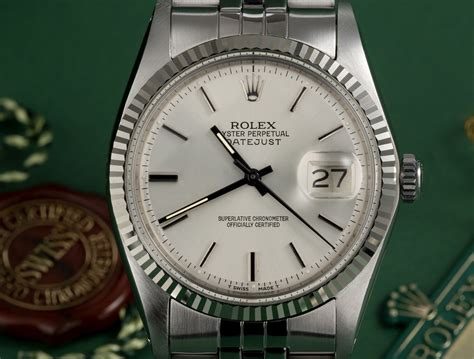
At a glance
Year ranges are the ones dealers and collectors use. Rolex does not publish production dates, so treat them as approximate to within a year or two.
One bar per generation, using collector dating. Most generations brought a new calibre; the Oysterquartz ran alongside the mechanical line for 25 years. Click a row to jump to its references.
References
Photos are web images found by searching for each reference number, credited where the source is known. Click one to enlarge. A photo shows one example of the reference, so dial and bracelet vary, and for a few rare early references the match could not be confirmed. Where sources describe a reference differently from its photo, the text follows the sources. If a photograph is yours and you want it credited or removed, write to me.
The first Datejust, 1945 – 1949
Bubble-back automatic with a slow date change around midnight. No Cyclops, and the dial does not yet say Datejust.
Case. 36 mm with a domed bubble-back, 20 mm between the lugs. Acrylic crystal, no Cyclops. About 1,000 made. Water resistance is given as 50 m or 100 m.
Short-run successors, 1948 – 1951
Same bubble-back movement. First steel-and-gold cases. Cases measure about 35.5 mm.
Case. 35.5 to 36 mm, with shorter lugs on the 5030. Acrylic crystal, no Cyclops.
Last of the old-school Ovettone, 1950 – 1953
Updated bubble-back automatic. Datejust begins to appear on the dial in this period.
Case. 36 mm bubble-back. The 6075 has a Super Oyster crown and is the last reference with the cut-off coronet on the dial.
Cyclops arrives, 1953 – 1956
18,000 vph automatic. Le Monde Edmond, Phillips and BeckerTime give cal. A296 for these references, dealer listings give 745, and 645 and 743 also appear. First Datejust with the Cyclops date magnifier.
Case. 36 mm. Single listings give about 13.7 mm thick and 44 mm lug to lug. Acrylic with Cyclops from 1953 to 1954. Twinlock crown introduced in 1953.
Instantaneous date, 1956 – 1959
First calibre whose date jumps instantly at midnight. Flatter caseback ends the bubble-back shape.
Case. 36 mm nominal, 35.7 mm measured. 11.8 mm thick, 20 mm lugs, 43.9 mm lug to lug. Acrylic with Cyclops. US list for a steel Datejust on Oyster in 1957: $255.
The 1600 family, 1959 – 1977
Cal. 1565 at 18,000 vph, then cal. 1575 at 19,800 vph from about 1965, with hacking seconds from about 1972. Bridges are stamped 1560 or 1570. Acrylic crystal, no quickset.
Case. 36 mm, 11.7 mm thick, 20 mm lugs, 43 to 44 mm lug to lug, drilled lugs. Acrylic with 2.5x Cyclops, Twinlock crown. Water resistance is given as 50 m or 100 m. US list in 1968: $250 for a steel 1603, $350 for a steel 1601.
Five digits, quickset date, 1977 – 1988
High-beat automatic at 28,800 vph with quickset date. Crystal stays acrylic for this family.
Case. 36 mm, 12 mm thick, 20 mm lugs, 44 mm lug to lug, drilled lugs. 100 m, Twinlock crown. US list for steel on Oyster: $495 in 1977, $985 in 1980.
Oysterquartz Datejust, 1977 – 2003
In-house quartz at 32 kHz with 11 jewels and thermocompensation. Angular case with integrated bracelet and sapphire crystal. Steel left the catalogue about 2001, the gold-bezel versions by 2003.
Case. 36 mm angular case, 13.5 mm thick, integrated bracelet tapering from 24 to 16 mm. Sapphire crystal, 100 m. Late-1980s list: CHF 2,950 for the 17000, CHF 5,750 for the 17013. Under about 25,000 Oysterquartz watches were made in all.
Sapphire crystal, 1988 – 2005
28,800 vph, 31 jewels, about 48 hours of reserve, full balance bridge. Sapphire crystal becomes standard.
Case. 36 mm, about 11.8 mm thick, 20 mm lugs, about 43.5 mm lug to lug. 100 m, Twinlock crown. Lug holes on early examples, gone from the mid 1990s. US list for steel on Oyster: $2,350 in 1989, $2,975 in 1996.
Six digits, 2005 – 2018
Same calibre, later with the blue Parachrom hairspring. Heavier case, solid-link bracelets, polished lugs. Start is given as 2004 to 2006, end as 2018 to 2020.
Case. 36 mm, just under 12 mm thick, about 44 mm lug to lug, no lug holes. 100 m, Twinlock crown. US list for steel on Oyster: $3,575 in 2004, $6,600 in 2012.
Current Datejust 36, 2018 – today
Chronergy escapement, about 70 hours of reserve, 31 jewels, rated to −2/+2 seconds a day. Two-tone versions came first in 2018, steel and white gold bezel versions followed in 2019.
Case. 36 mm, 11.5 mm thick, 20 mm lugs, 44.0 mm lug to lug, 118 to 124 g on the bracelet. 100 m, Twinlock crown, Chromalight lume. US list in 2026 from $8,150.
Movements
Click a calibre to filter the references that use it. Empty cells mean I found no reliable figure.
| Calibre | In the Datejust 36 | Beat rate | Jewels | Reserve | Date | Hacking | Notes |
|---|---|---|---|---|---|---|---|
| 1945 to c. 1951 | 18,000 vph | Slow change near midnight | No | Bubble-back rotor needs the domed caseback. Two sources list the 4467 as cal. 710. | |||
| c. 1950 to 1956 | 18,000 vph | 18 | Slow change | No | Updated bubble-back automatic. | ||
| c. 1953 to 1956 | 18,000 vph | Slow change | No | Introduced in 1952. Named for the 6305 by dealers; auction houses give A296. | |||
| c. 1956 to 1959 | 18,000 vph | Instant jump at midnight | No | Butterfly rotor. Flatter movement that ended the bubble-back case. Also reported as 1066. | |||
| 1959 to c. 1965 | 18,000 vph | 26 | about 42 h | Instant, no quickset | No | Bridge is stamped 1560. Microstella regulation. | |
| c. 1965 to 1977 | 19,800 vph | 25 or 26 | about 48 h | Instant, no quickset | From 1971 to 1972 | Bridge is stamped 1570. Set the date by winding the hands past midnight. Made until 1981 for other models. | |
| 1977 to 1988 | 28,800 vph | 27 | 42 to 50 h, sources differ | Quickset from the crown | Yes | First Rolex calibre with quickset date. Balance cock, not a bridge. | |
| 1977 to c. 2003 | 32 kHz quartz | 11 | battery, 2 to 3 years | Quickset | Yes | Thermocompensated quartz, Oysterquartz only. Chronometer-certified from about 1979. | |
| 1988 to c. 2019 | 28,800 vph | 31 | 48 to 50 h | Instant, quickset | Yes | Full balance bridge. Blue Parachrom hairspring from 2000 or 2005, sources differ. About 20 million made across all models. | |
| 2018 to today | 28,800 vph | 31 | about 70 h | Instant, quickset | Yes | Chronergy escapement, rated to −2/+2 seconds a day. Introduced in 2015, in the 36 mm case from 2018. |
Weak points and service
- A295, A296, 745. No longer serviced by Rolex, and parts are hard to get. Budget for a specialist.
- 1065. The point from which servicing becomes practical, according to one buyer's guide.
- 1565 and 1575. The barrel bridge and centre wheel run without jewels and wear; the repair is to fit bushings. Weak date springs give a slow date change. Rolex does not supply parts to independent watchmakers, and genuine parts are getting scarce. Service every 5 to 7 years.
- 3035. The rotor axle and its jewels wear faster than on the 3135. The quickset can leave the date hanging half way. Dial feet often break during service.
- 5035. Parts are very hard to get, and a failed circuit can end the movement. Rolex service runs about $800 to 1,500, independents $500 to 1,000.
- 3135. The best-supported calibre for parts. Its common fault is rotor axle wear after ten or more years without service: the loose rotor scrapes the bridges and sheds metal dust.
- 3235. A reported low-amplitude fault: after one to three years the watch loses 10 to 30 seconds a day and the reserve drops to 30 to 40 hours. The cause given is lubrication at the second wheel pivot. It is repaired under the five-year warranty; sources differ on whether Rolex has acknowledged it.
- Cost. A Rolex service for a steel Datejust 36 runs about $800 to 1,100, independents 30 to 50 percent less. Rolex recommends service about every ten years and gives a two-year service warranty.
Design by era
What changed on the outside, generation by generation. Use it to check that the parts of a watch belong to the same period.
| Feature | 1945 to 1959 | 1600 family, 1959 to 1977 | 160xx, 1977 to 1988 | 162xx, 1988 to 2005 | 1162xx, 2005 to 2018 | 1262xx, 2018 on |
|---|---|---|---|---|---|---|
| Dial markers and hands | Applied dagger, arrow or triangle markers with alpha hands. Honeycomb and gilt dials | Pie-pan dial with dagger markers and alpha hands at first; baton markers and stick hands from the mid 1960s | Flat dial. Stick, Roman, Arabic or diamond markers | Stick, Roman, Arabic or diamond markers in many colours | Same styles. Roulette date wheel on some | No minute track on plain dials. Palm and fluted motif dials from 2021 |
| Chronometer text | Chronometre, then Officially Certified Chronometer. Superlative Chronometer Officially Certified from 1956 to 1957 | Superlative Chronometer Officially Certified | Same | Same | Same | Same, with −2/+2 seconds a day behind it since 2015 |
| Date wheel | Black, then all red, then roulette (alternating red and black) from 1947. Open 6 and 9 | Black. Closed 6 and 9 in the 1960s, open again from about 1970 | Black | Black | Black; roulette revived on some dials, 2004 to 2018 | Black |
| Crystal | Acrylic. Cyclops from 1953 to 1954 | Acrylic with Cyclops | Acrylic with Cyclops | Sapphire with Cyclops. Laser-etched coronet at 6 from 2002 to 2004 | Sapphire with etched coronet | Sapphire |
| Case | Bubble-back with domed caseback until c. 1956, then flat | Flat caseback, drilled lugs | Same case shape, drilled lugs | Lug holes until the mid 1990s | Thicker, fully polished lugs, no lug holes | Slimmer, more tapered lugs and flatter case sides |
| Thickness | About 13.7 mm as a bubble-back, 11.8 mm from 1956 | 11.7 mm | 12 mm | About 11.8 mm | Just under 12 mm | 11.5 mm |
| Crown | Screw-down Oyster crown. Twinlock from 1953 | Twinlock | Twinlock | Twinlock | Twinlock | Twinlock |
| Water resistance | 50 m or 100 m, sources differ | 50 m or 100 m, sources differ | 100 m | 100 m | 100 m | 100 m |
| Setting the date | Hands only | Hands only | Quickset | Quickset | Quickset | Quickset |
| Lume and text at 6 | Radium, "Swiss" | Radium to the early 1960s, then tritium, "T Swiss T" or "Swiss – T < 25" | Tritium | Tritium to c. 1998, Luminova "Swiss" 1998 to 1999, then Super-LumiNova "Swiss Made" | Super-LumiNova, "Swiss Made" | Chromalight with a blue glow, "Swiss Made" |
| Bezels offered | Coin-edge, fluted, smooth, engine-turned, rotating | Smooth, fluted, engine-turned, bark, rotating | Smooth, fluted, engine-turned, bark, rotating | Smooth, fluted, engine-turned, bark, rotating | Smooth, fluted, diamond-set, rotating until 2011 | Smooth, fluted, diamond-set |
| Jubilee bracelet | Solid gold only at first | Folded-link 6251H with 55 end links, c. 1959 to the early 1970s. US-made oval-link versions also exist | 62510H in steel, 62523H in two-tone: hollow centre links, solid outer links, 455 or 555 end links | Same 62510H and 62523H | Solid Super Jubilee 63200 or 63600 with solid end links and concealed Crownclasp | Solid links, Oysterclasp with 5 mm Easylink |
| Oyster bracelet | Riveted 6635 and 7205 from 1954 | Riveted 7205, then folded 7835 from 1967 | Solid-link 78350 and 78360 from 1975 | 78360 with 558B end links | Solid 72200 with Easylink | Solid 72600 series with Easylink |
| Serial location | Between the lugs at 6 | Between the lugs at 6 | Between the lugs at 6 | Between the lugs at 6 | Lugs and rehaut from 2005, rehaut only from 2008 | Rehaut |
Dial types collectors name
Date a watch
The serial number is engraved between the lugs at 6 o'clock, so the bracelet has to come off to read it. From 2005 Rolex also engraved it on the inner bezel ring (the rehaut), and from 2008 only there. The reference number sits between the lugs at 12 o'clock.
Show the full serial table
| Serial from | Year |
|---|---|
| 302,459 | 1945 (first run) |
| 367,946 | 1946 (first run) |
| 529,163 | 1947 (first run) |
| 628,840 | 1948 (first run) |
| 726,639 | 1952 (first run) |
| 855,726 | 1953 (first run) |
| 23,000 | 1954 |
| 97,000 | 1955 |
| 133,061 | 1956 |
| 224,000 | 1957 |
| 328,000 | 1958 |
| 399,453 | 1959 |
| 516,000 | 1960 |
| 643,153 | 1961 |
| 744,000 | 1962 |
| 824,000 | 1963 |
| 1,008,889 | 1964 |
| 1,100,000 | 1965 |
| 1,200,000 | 1966 |
| 1,538,435 | 1967 |
| 1,752,000 | 1968 |
| 1,900,000 | 1969 |
| 2,241,882 | 1970 |
| 2,589,295 | 1971 |
| 2,890,459 | 1972 |
| 3,200,268 | 1973 |
| 3,567,927 | 1974 |
| 3,862,196 | 1975 |
| 4,115,299 | 1976 |
| 5,000,000 | 1977 to 1978 |
| 5,737,030 | 1979 |
| 6,434,000 | 1980 |
| 6,520,870 | 1981 |
| 7,100,000 | 1982 |
| 7,400,000 | 1983 |
| 8,070,022 | 1984 |
| 8,614,000 | 1985 |
| 8,900,000 | 1986 |
| 9,400,000 | 1987 |
| R + 6 digits | 1987 to 1988 |
| L + 6 digits | 1989 |
| E + 6 digits | 1990 |
| X + 6 digits | 1991 |
| N + 6 digits | 1991 |
| C + 6 digits | 1992 |
| S + 6 digits | 1993 to 1994 |
| W + 6 digits | 1995 |
| T + 6 digits | 1996 |
| U + 6 digits | 1997 to 1998 |
| A + 6 digits | 1999 |
| P + 6 digits | 2000 |
| K + 6 digits | 2000 to 2001 |
| Y + 6 digits | 2001 to 2002 |
| F + 6 digits | 2003 to 2005 |
| D + 6 digits | 2005 to 2006 |
| Z + 6 digits | 2006 to 2007 |
| M + 6 digits | 2007 to 2008 |
| V + 6 digits | 2008 to 2009 |
| G + 6 digits | 2010 |
| 8 mixed characters | 2011 on |
Dial text at 6 o'clock
| Text | Lume | Period | What a mismatch means |
|---|---|---|---|
| Swiss | Radium | Until the early 1960s | On a later watch this text can also be Luminova, see below. |
| T Swiss T, Swiss – T < 25 | Tritium | Early 1960s to c. 1998 | Tritium text on a watch made after 1998 means a swapped dial. |
| Swiss | Luminova | 1998 to 1999 | Expect it on watches with U and A serials. |
| Swiss Made | Super-LumiNova, then Chromalight | 2000 on | On a watch from before 2000 it marks a later service dial. |
Clasp code
From 1976 to 2010 the inside of the clasp blade carries a letter code for the year and a number for the month. It dates the bracelet, which should sit within a year or so of the watch. An extra S marks a service replacement.
Show the clasp code table
| Year | Code |
|---|---|
| 1976 | A or VA |
| 1977 | B or VB |
| 1978 | C or VC |
| 1979 | D or VD |
| 1980 | E or VE |
| 1981 | F or VF |
| 1982 | G |
| 1983 | H |
| 1984 | I |
| 1985 | J |
| 1986 | K |
| 1987 | L |
| 1988 | M |
| 1989 | N |
| 1990 | O |
| 1991 | P |
| 1992 | Q |
| 1993 | R |
| 1994 | S |
| 1995 | T or W |
| 1996 | V |
| 1997 | Z |
| 1998 | U |
| 1999 | X |
| 2000 | AB |
| 2001 | DE |
| 2002 | DT |
| 2003 | AD |
| 2004 | CL |
| 2005 | MA |
| 2006 | OP |
| 2007 | EO |
| 2008 | PJ |
| 2009 | LT |
| 2010 | RS |
| 2011 on | Three random characters |
Other markings
| Marking | Where | What it tells you |
|---|---|---|
| Reference number | Between the lugs at 12 o'clock | The model. Its last digits must match the bezel and metal on the watch. |
| Serial number | Between the lugs at 6; on the rehaut from 2005, only there from 2008 | The production year, through the lookup above. |
| Quarter and year, such as III.65 | Inside the caseback, until about 1972 | Roughly when the case was made. Casebacks were swapped at service, so it supports a date but does not prove it. |
| Small coronet etched in the crystal | At 6 o'clock, from 2002 to 2004 on | Original sapphire of the period. An etched S marks a service replacement crystal. |
| ROLEX ROLEX ROLEX and serial | Engraved on the rehaut, from 2005 | Its absence on a watch after about 2008 is a warning sign. |
| Marks under the crown coronet | On the winding crown | A dash means a steel or two-tone Twinlock crown, two dots gold, one dot platinum. |
| Hallmarks: 750, Helvetia head, St Bernard head | Caseback, mid-case and clasp of gold watches | 18k gold. The St Bernard head is used from 1995. |
| Bracelet reference and end-link number | Inside the last link and on the end links | Whether the bracelet type belongs to the generation; see Design by era. |
Buying and selling checks
Originality and condition move the price of a Datejust more than the reference does. A refinished dial can cut the value by half or more. Check these points before pricing or buying one.
What moves the price
| Factor | Effect on price |
|---|---|
| Box and papers | Plus 10 to 25 percent; some dealers quote 20 to 40 percent for a full set |
| Unpolished case | Plus 15 to 30 percent on vintage, 10 to 15 percent on modern |
| Over-polished case | Minus 15 to 25 percent, up to 45 percent in bad cases |
| Refinished dial | Minus 50 percent or more |
| Aftermarket diamonds, custom dial or bezel | Minus 40 to 60 percent |
| Non-original bracelet | Minus 25 to 40 percent |
| Buckley dial | Plus 15 to 25 percent |
| Tiffany-stamped dial | Plus several thousand dollars |
| Repair costs to budget | Bracelet stretch repair from $350, Jubilee rebuild $300 to 1,200, dial replacement $500 to 1,000, fluted gold bezel $1,000 to 2,500, full service $800 to 1,100 |
Reading the codes
- 0
- Steel
- 1
- Steel and Everose gold (six-digit era)
- 3
- Steel and yellow gold
- 4
- Steel with white gold bezel
- 5
- Everose gold
- 6
- Platinum
- 8
- 18k yellow gold
- 9
- 18k white gold
- 0
- Smooth (16000, 16200, 126200)
- 1
- Fluted in the 160xx family (16013, 16014)
- 2
- Engine-turned (16220)
- 3
- Engine-turned on 16030, fluted from 162xx on (16233, 126234)
- 4
- Diamond-set on 1162xx (116243, 116244)
- 5 / 6
- Rotating Turn-O-Graph (16253, 16264, 116264)
- 8
- Diamond-set on 1262xx (126284RBR)
The meaning of this digit shifted between generations, so read it together with the family prefix.
- 16xx
- Cal. 1565 / 1575
- 160xx
- Cal. 3035
- 170xx
- Oysterquartz, cal. 5035
- 162xx
- Cal. 3135, sapphire crystal
- 1162xx
- Cal. 3135, solid-link bracelets
- 1262xx
- Cal. 3235
- 6305-1
- Broader fluting on the bezel
- 6305-2
- Stepped bezel, one of the rarest Datejusts
- 1602, 1605
- Gold variants with Florentine-finish bracelet and with the triangular "piranha" bezel
- /3 /8 /9
- Four-digit metal suffix: 1601/3 two-tone, 1601/8 yellow gold, 1601/9 white gold
- RBR
- Bezel set with round brilliant diamonds
36 mm references not in the catalog above
| Reference | Metal | Bezel and bracelet |
|---|---|---|
| 116135 | Everose gold | Fluted, on leather strap |
| 116138 | 18k yellow gold | Fluted, on crocodile strap with gold folding clasp |
| 116139 | White gold | Fluted, on leather strap |
| 116188 | Yellow gold | Diamond bezel, on leather strap |
| 116189 | White gold | Diamond bezel, on crocodile strap |
| 116241 | Steel and Everose gold | Diamond-set bezel. Single source |
| 116185, 116199, 116208, 116285 | Not found | Listed by one dealer as 36 mm men's Datejusts, without details |
The catalog also leaves out the 41 mm Datejust II and Datejust 41, the 31 mm and Lady-Datejust sizes, and the many gem-set and special-order versions of the references it does list.
Milestones
| Date | Event |
|---|---|
| 1945 | Datejust launched as ref. 4467 in 18k gold for Rolex's 40th anniversary, on the new Jubilee bracelet. |
| 1947 | Winston Churchill receives a rose gold Datejust. Roulette date wheels appear. |
| c. 1948 to 1950 | Refs 5030 and 5031 add new case shapes and steel-and-gold cases. |
| 1950 | Two platinum Datejusts made as ref. 6074. |
| 1950 or 1951 | Dwight Eisenhower is given the 150,000th Rolex chronometer, a yellow gold Datejust. |
| Early 1950s | The word Datejust appears on the dial. |
| 1953 | Twinlock crown introduced. |
| 1953 to 1954 | Cyclops date magnifier introduced on the 6304 and 6305, the first Datejusts in steel. |
| 1954 | First Datejust Turn-O-Graph, ref. 6309. |
| c. 1955 to 1957 | Calibre 1065 brings the date that jumps at midnight; the bubble-back case ends. Dial text becomes Superlative Chronometer Officially Certified. |
| 1959 | The 1600 family sets the lasting form of the 36 mm Datejust. |
| 1964 | Martin Luther King Jr. wears a gold 1601 at the Nobel ceremony. |
| c. 1965 | Calibre 1575 raises the beat rate to 19,800 vph. |
| 1971 to 1972 | Hacking seconds added. |
| 1976 | Clasp date codes begin. |
| 1977 | Calibre 3035 with quickset date in the 160xx family; pie-pan dials end. Oysterquartz Datejust launched. |
| 1985 | Jubilee-motif anniversary dial for the model's 40th year. |
| 1988 | Calibre 3135 and sapphire crystal in the 162xx family. |
| Mid 1990s | Lug holes disappear. |
| 1998 to 2000 | Tritium lume replaced by Luminova, then Super-LumiNova. |
| 2002 to 2004 | Laser-etched coronet added to the crystal. |
| 2004 to 2005 | Six-digit 1162xx family with solid bracelets. Turn-O-Graph relaunched for its 50th anniversary with red seconds hand. |
| 2005 | Serial and ROLEX engraved on the rehaut. |
| 2009 | Datejust II adds a 41 mm case beside the 36 mm. |
| 2011 | Turn-O-Graph discontinued. Clasp codes and serials become random. |
| 2015 | Five-year warranty and the −2/+2 seconds a day standard for all Rolex watches. |
| 2016 | Datejust 41 replaces the Datejust II and brings calibre 3235. |
| 2018 | Datejust 36 moves to calibre 3235 as the 1262xx family, two-tone first. |
| 2019 | Steel 126200 and white gold bezel 126234 follow. |
| 2021 | Palm and fluted motif dials. |
| 2024 | Olive green palm dial discontinued. |
Where the sources disagree
The catalog uses the version most sources give. To date an individual watch, rely on its serial number and movement, not the reference alone.
| Question | Version A | Version B |
|---|---|---|
| End of the 4467 | 1948 (WristBuzz) | About 1949 (WatchGuys, Monochrome); into the 1950s (Robb Report, BeckerTime) |
| Calibre of the 4467 | A295 (Le Monde Edmond, WatchGuys, BeckerTime) | Cal. 710 (Monochrome, Watches.co.uk, Grand Caliber) |
| What the 5031 is | Engine-turned twin of the 5030 (Monochrome) | The two-tone version (Watches.co.uk) |
| What the 6074 is | Platinum, two made in 1950 (Le Monde Edmond, Monochrome) | Smooth-bezel twin of the 6075 in gold or two-tone (Ancienne) |
| First dial signed Datejust | 6074 and 6075, about 1950 (Ancienne, Craft + Tailored) | 6105 (Le Monde Edmond, Robb Report); 1954 (Gear Patrol); 1957 (Analog:Shift) |
| First Cyclops | 1953 to 1954 on the 6304 and 6305 (Rolex, Watches.co.uk, Gear Patrol) | On the 6104 (Monochrome); with the 6604 and 6605 (BeckerTime) |
| Calibre of the 6305 | A296 (Le Monde Edmond, Phillips, BeckerTime) | 745 (dealer listings); 645 (WristBuzz) |
| Calibre of the 6605 | 1065 (Le Monde Edmond, BeckerTime, Watches.co.uk) | 1066 (WristBuzz, one dealer listing) |
| Instant date, cal. 1065 | 1955 (Grand Caliber, Wikipedia) | 1956 (Le Monde Edmond, Monochrome); 1957 (Gear Patrol, Watches.co.uk) |
| Water resistance before 1977 | 50 m (WristBuzz) | 100 m (WatchGuys, Monochrome) |
| Start of the 1600 family | 1959 (WatchGuys) | 1960 (WristBuzz) |
| First hacking seconds | 1971 to 1972, on cal. 1570 (WristBuzz, Quill & Pad) | With the 1560 and 1570 from the start (Analog:Shift) |
| Crystal of the 160xx family | Acrylic until 1988 (WatchGuys, Bob's Watches, Monochrome) | Sapphire by the end of the run (BeckerTime, WristBuzz) |
| Reserve of cal. 3035 | 42 h (Bob's Watches, BeckerTime) | 48 h (Grail Watch, WristBuzz); about 50 h (WatchGuys) |
| Start of the 162xx family | 1988 (WatchGuys, Monochrome) | 1989 (BeckerTime, Wrist Whisperer) |
| Parachrom hairspring in the 3135 | 2000 (BeckerTime, OTTUHR) | 2005 (WristBuzz) |
| Start of the 1162xx family | 2004 (Gray & Sons, WatchGuys) | 2005 (Watches.co.uk); 2006 (WristBuzz); 2009 (5D Watches) |
| Calibre of the 16263 and 16264 | 3135, as for all 162xx references (BeckerTime) | 3035 (SwissWatchExpo) |
| End of the Oysterquartz | 2001, last catalogue for steel | 2002 (Analog:Shift); 2003 (BeckerTime) |
| 126200 and 126234 launch | 2019 (WatchGuys, Rob's Rolex Chronicle) | 2018 with the family (WristBuzz) |
| Eisenhower's Datejust | Presented in 1950 (Rolex) | 1951 (The Jewellery Editor, Rolex Magazine) |
Prices and sources
About the prices
Collected in October 2026. Euro ranges are the lowest and highest asking prices on Wristler's European listings for that reference, so they include outliers such as diamond dials and unworn full sets. Dollar ranges are the typical pre-owned ranges US dealers publish. Rows marked as an era, family or all-gold guide share one published range across several references and are the least precise. Rows with no sourced range are rare or thinly traded references for which I found no reliable figure. Retail prices are US list prices for 2026.
Sources
- WristBuzz, All Rolex Datejust References 1945-2026
- WatchGuys, Rolex Datejust Buyer's Guide
- Le Monde Edmond, Datejust: a closer look at a Rolex icon
- Robb Report, The History of the Rolex Datejust
- Gear Patrol, Everything You Need to Know to Buy a Rolex Datejust
- SwissWatchExpo, Rolex Turn-O-Graph Ultimate Guide
- BeckerTime, History of the Rolex Oysterquartz
- Gray & Sons, Datejust 116200 Series Overview
- Watches.co.uk, History of the Rolex Datejust
- Wristler, asking prices per reference (EUR)
- WatchGuys, per-reference pre-owned ranges (USD)
- 5D Watches, Rolex Datejust Buying Guide (retail and secondary, May 2026)
- Estimonia, Rolex Datejust Value Guide (auction results)
- Sebastian Charles, vintage Datejust values
- SwissWatchExpo, Turn-O-Graph prices
- Bob's Watches, Oysterquartz guide
- Bob's Watches, Rolex serial numbers
- Bob's Watches, Vintage Rolex Dials
- Bob's Watches, History of the Rolex Datejust
- Everest, Comparing Every Rolex Lume
- WristBuzz, calibre pages for 1570, 3035, 3135, 3235
- Analog:Shift, A Brief Guide to the Rolex Datejust
- WatchProSite, Jubilee bracelet 6251H
- Le Monde Edmond, Datejust: a closer look, part 2
- Monochrome, Rolex Datejust complete history
- BeckerTime, 1940s versus 1950s Datejust, and reference reviews for 16013, 16018, 16220, 16234, 16253, 16263
- BeckerTime, Rolex bracelets and clasps
- WatchGuys, Datejust 1601 and 16234 reviews
- Goldammer, Oysterquartz Datejust guide
- Worn & Wound, Oysterquartz 17013 owner's review
- Rolex, Datejust 36 models and list prices
- Rolex, Datejust big dates
- Monochrome, Datejust 36 ref. 126231 review
- Sweeping Hand, Rolex bracelet codes
- Everest, decoding the bracelet date code
- Millenary Watches, bracelet reference numbers and hallmarks
- Atelier de Griff, vintage Rolex case details
- Luxury Bazaar, special Rolex dials and the roulette date
- Bob's Watches, Buckley dial; service costs
- Wind Vintage, Rolex prices in 1968 and the Wide Boy dial
- Minus4Plus6, US list price evolution
- Diamond Banc, condition and value
- Luxury Watches USA, modified Rolex values
- Quill & Pad, calibre 1575
- Watch Repair Talk, cal. 3135 issues
- Toronto Watch Exchange, cal. 3235 low amplitude
- Boss Hunting, the American Psycho watch