Omega's Genève line, 1952 to 1981
Omega Genève
Every Genève reference found, in production order: the small-seconds watches of the 1950s, the 600-series hand-winds, the 1960s and 1970s automatics, Dynamic, Chronostop, the f300 Electronic, Megaquartz, two-hand dress watches and the ladies' line.
Origins
The name Genève first appears on Omega dials in the early 1950s. Most sources give 1952 or 1953; ref. 2903-1 existed by 1953, and the earliest example a dealer has verified carries a 1954 serial. The name honoured the observatory results of Omega's 30 mm calibre, which won first prize at the Geneva Observatory in 1945, and the Geneva workshops where much of the assembly was done.
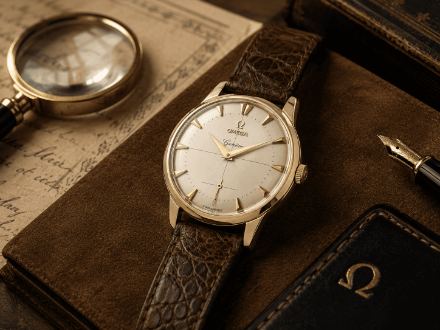
In the 1950s the Genève sat near the top of the range. Forum historians place it at the head of Omega's hand-wound watches, with the Constellation heading the automatics. The watches had chamfered lugs, gold or hand-riveted markers and the 30 mm small-seconds calibres, in Staybrite steel, 18k and, for Britain, 9ct gold cases by Dennison.
From the mid 1960s the line changed. Omega's Geneva factory had closed by about 1967, the same year De Ville became a collection of its own, and Genève turned into Omega's volume line: about the cheapest Omega on sale around 1970 and, by several accounts, some 60 percent of production. The movements were the 601, 613, 552 and 565 used in Seamasters and De Villes of the same years. What differed was a simpler case and a lower price. Between about 1965 and 1967 some dials were signed Seamaster Genève.
The Genève also carried Omega's new ideas to a wide public: the single-pusher Chronostop (a Seamaster in 1966, a Genève from 1967), the elliptical Dynamic of 1968, the f300 Hz tuning-fork Electronic from 1971 and the Megaquartz 32 kHz of 1974. Several of them moved to the De Ville name within a few years.
The name was dropped in 1979, while Omega's parent company SSIH was struggling through the quartz crisis; the banks rescued it in 1981. Geneva's rules on using the city's name on a dial are the usual explanation for the timing, but no source confirms it. Omega's archive still lists one Genève wristwatch, the hand-wound 336.0803, until 1981 and a Genève pocket watch until 1985. Omega has not revived the name since.
At a glance
Each entry gives the reference, years, calibre, case and dials, what collectors look for and what it sells for.
One bar per family, from the first dated reference to the last. Families overlap: the Genève sold hand-winds, automatics, a chronograph, a tuning-fork watch and a quartz watch side by side in the early 1970s. Click a row to jump to its references.
References
Photos are Omega's own archive images for 112 entries and dealer or auction photos for 57 more, credited where the source is known. Click one to enlarge. A dealer photo shows one example and may not show every detail of the reference. One of 170 entries has no photo; the More photos link searches for one. If a photograph is yours and you want it credited or removed, write to me.
The first Genèves: 30 mm calibres, 1952 – 1962
Omega's 30 mm family: cal. 266, 267 and 268 with small seconds, 17 jewels and 18,000 vph, and the centre-seconds 285. The ultra-thin hand-wound 540 appears in gold dress pieces. From 1960 the thinner 28 mm 600 series takes over, with the 610 adding a date. The italic Genève script belongs to this period.
Cases. Press-in or snap backs, not water resistant, 33.5 to 36 mm. Staybrite steel, 18k, and 9ct gold in British cases by Dennison. Case numbers before 1962 carry no coded meaning; the letter prefix gives the metal (CK steel, OT 18k).
Early automatics, 1956 – 1962
The 1950s full-rotor automatics, cal. 491 with small seconds and cal. 503 with date, then from 1958 the 550 family: cal. 552 with 24 jewels and no date, cal. 562 with date set through the hands. 19,800 vph.
Cases. Press-in backs and hermetic crowns, steel or 18k. Hand-riveted gold markers and faceted gold hands were standard.
The 600-series hand-winds, 1962 – 1976
Cal. 600 (1960 to 1964) and 601 (1962 to 1970): 27.9 mm casing diameter (28.4 overall), 3.35 mm high, 17 jewels, 19,800 vph, centre seconds, about 48 hours. Date versions: 611 (1962 to 1967, set by turning the hands through midnight) and 613 (1967 to 1973, quickset by the crown). Cal. 602 is the 17-jewel chronometer version, found only in the 137.001.
Cases. Six-digit references from 1962: 131 and 132 for cases that are not water resistant (press-in back), 135 and 136 for water-resistant screw backs, 137 for the chronometer. Steel, 20-micron gold plate (ME, JE, MD) or 18k (BA). Most have 18 mm lugs.
Two-hand dress watches and tanks, 1962 – 1979
Cal. 620 (1960 to the early 1970s): about 18 mm across and 2.5 mm thick, 17 jewels, 19,800 vph, hours and minutes only. Cal. 625, in use by 1973, replaced it at 21,600 vph; about 2.4 million were made by 1979.
Cases. 111 references: men's watch, hand-wound, no seconds, not water resistant, press-in back. Solid 18k early, steel and 20-micron plate in the 1970s.
Automatics of the 1960s, 1962 – 1976
Cal. 552 (24 jewels, no date) and its 17-jewel 550; 562 with date set through the hands; 563 and 565 with quickset date from 1966 (27.9 mm, 5 mm high, 38 hours); 750 and 752 with day and date. All 19,800 vph.
Cases. 161 and 162 for cases that are not water resistant (press-in back), 165 and 166 for water-resistant screw backs. Gold-plated cases read plaqué or G 40 microns inside, with a steel back. Mostly 34 to 35 mm with 18 mm lugs.
Amirauté (Admiralty), 1967 – 1970
The sport Genèves, on the same hand-wound 601 and 613 and automatic 552 and 565 as the rest of the line. Omega uses the name Amirauté only for the 165.0038 and 166.0038; collectors add the anchor-dial and bezel siblings.
Cases. Steel, 35 to 37 mm, screw backs, cases by EPSA. The bracelet models have 17 mm lugs and a Fixo-Flex 1122/563 bracelet; the bezel models have 18 mm lugs and a rotating 60-minute bezel. Dials: black military with Arabic numerals, orange hour marks and an anchor at 6; white with riveted block markers; grey; silver sunburst.
Genève Dynamic, 1967 – 1979
The first Dynamics use the hand-wound 601 and 613 and the automatic 552, 565 and 752; later cases take the 1481, 1012 and 1022. Ladies' Dynamics use the 671, 681 and 684.
Cases. Elliptical one-piece Unishell case designed by Raymond Thévenaz, 41.5 × 36.4 × 10.5 mm for men, 30 m, opening through the crystal side. The strap or bracelet mount sits in a channel round the case and is held by a threaded ring, removed with Omega tool 206; the crystal tool is 107. Bracelet 1153/138 or Corfam strap. Launched to the public in 1968 (Omega catalogues the 165.0039 from 1967) and sold as De Ville Dynamic from about 1971, while Genève Dynamics continued to 1979; over a million made by 1972.
Genève Chronostop, 1966 – 1972
Cal. 865 (no date) and 920 (date): hand-wound, from the Lemania-designed 860 line, 21,600 vph, no hacking. One pusher at 2 starts, stops and resets a centre chronograph hand, which cannot restart without a reset. About 124,000 cal. 865 and 61,000 cal. 920 were made.
Cases. 35 mm case with 18 mm lugs, crown at 4, screw back without the seahorse, 30 m. Racing models have a radially brushed bezel, Japanese-market ones a polished bezel. Bracelets: 1120/116 Milanese, early 1035 flat-link, later 1098. The Chronostop started as a Seamaster in 1966 and became a Genève in 1967.
Automatics of the 1970s, 1971 – 1979
Cal. 1480 and 1481: Tissot-designed, 17 or 21 jewels, 21,600 vph, date set by pressing the crown in, serial printed in ink. Cal. 1010 and 1012 (1972 to 1984): 28,800 vph, hacking, quickset date, 23 jewels on the 1012, 4.25 mm high. Cal. 1020 and 1022 add the day. Plastic parts in the 10xx calendar work are the known weak spot.
Cases. Round 34.5 to 36 mm screw-back cases, shaped TV and cushion cases of 37 mm, and integrated bracelets with a separate 366.08xx reference for the complete watch: 166.0173 is 366.0832, 166.0174 is 366.0833.
Hand-winds of the 1970s: cal. 1030, 1972 – 1981
Cal. 1030: 27.9 mm, 3.7 mm high, 17 jewels, 28,800 vph, hacking, quickset date, about 45 hours. It shares parts with the 1012 and replaced the 613; about 314,000 were made from 1974 to 1984.
Cases. 132 cases with press-in backs, 136 cases with screw or press-in backs, 35 to 36 mm, and the 336.0803 on an integrated bracelet, which Omega's archive lists until 1981: the last Genève wristwatch reference found.
Genève Electronic f300, 1970 – 1977
Tuning fork at 300 Hz, Max Hetzel's design produced by ESA: cal. 1250 (ESA 9162, date) and 1260 (ESA 9164, day and date), 12 jewels, chronometer certified, copper-plated. Omega's archive also lists two Genève Megasonics with the 720 Hz cal. 1220, which shared case numbers with the f300.
Cases. 198 references: electronic, water resistant, chronometer with calendar. Dials say f300Hz and often have a red ring round the Ω. Bracelet versions carry 398 numbers; a third group appears: .169 for the date-only f300 (1250) and .170 for day-date (1260), a pattern inferred from examples.
Genève Megaquartz and quartz, 1973 – 1979
Cal. 1310 Megaquartz 32 kHz (32,768 Hz), Omega's own quartz movement, shown at Basel in 1973 and sold from 1974: day and date, hacking, independently set hour hand, trimmer, 8 jewels. Cal. 1320 is the date-only sister. Coils are hard to find and must not be demagnetised.
Cases. 196 references: electronic, water resistant, calendar; 396 for the bracelet version; 596 for ladies'. Barrel-shaped press-in cases of 39 × 44 mm, some made by Huguenin Frères, with the Ω on a red medallion at 12.
Ladies' Genève, 1962 – 1977
Hand-wound: the tiny 485 of the Saphette family, the slim 620 and 625, and the centre-seconds 630. Automatic: 670 and 671 without date, 680, 681 and 684 with date, all 24 jewels.
Cases. 511 is a lady's hand-wound watch without seconds, 535 hand-wound with centre seconds, 562, 565 and 566 automatics, 711 and 766 bracelet watches. From 17.5 mm square to 33 mm.
The Genève pocket watch, 1971 – 1985
Hand-wound cal. 960.
Cases. The last product to carry the Genève name, listed by Omega six years after the wristwatch line ended.
Other numbers
Numbers you will meet sold as Genève that Omega files under another line, numbers that could not be confirmed, and close relatives from other lines. They are kept out of the catalog above so that every entry there is a confirmed Genève.
| Number | Status | What is known |
|---|---|---|
| 2750 · 2750-6 | Not Genève in Omega's archive | Omega files CK 2750 under Other: 1954, cal. 266, steel, press-in back. Some dealers list the 2750-6 as Genève; no Genève-signed dial has been shown. |
| 2791 · 2791-6 | Seamaster | Omega lists KO 2791 as a Seamaster: 1954, cal. 266 or 267. Dealers sell the 2791-6 as an early Seamaster dress watch. |
| 2800 · 2800-3 | Not Genève in Omega's archive | Omega files CK 2800 under Other: 1954, cal. 266, 35 mm. A UK dealer sells the 2800-1 as a Jumbo; no Genève dial confirmed. |
| 131.012 · 131.0012 | Other in Omega's archive | 1962, cal. 600, steel, 34 mm, hand-riveted gold markers, stick hands. The press-in sibling of the 131.019, but Omega does not call it a Genève. |
| 131.014 | Signature not confirmed | 18k rose gold, 35 mm, cal. 286, about 1962, matte silver dial with gold batons. $1,000 at auction in New York, April 2014. |
| 131.0042 | Sold as Genève, not in Omega's archive | Steel, 31 to 33 mm, champagne, gold or silver dials; a 1971 example was sold in Norway as Genève. Calibre not stated. |
| 14732 · 14732-1 SC | Not confirmed | Steel, 35 mm, black, blue, silver or white dials; recorded at $350–577 in 2025. No Omega entry and no dealer description found. |
| 131.8412 · 132.5017 · 132.9051 | Gold case numbers, not confirmed | Yellow gold, 33 to 36 mm, silver or gold dials, listed as Genève at about $1,250–2,500 in 2025–26; the 131.8412 is 9ct. They do not follow Omega's usual numbering and may be cases made outside Switzerland, like the 9ct British Genèves. |
| 121.0005 | Not confirmed | One yellow gold, 34 mm example listed as Genève in 2026. |
| 165.0042 | Not confirmed | No listing found. Possibly a no-date bezel Amirauté, by analogy with the 135.0042; treat as unverified. |
| 166.0312 | Not Genève | A 1990s Dynamic or Classic with the ETA-based cal. 1108, 36.5 mm. Sometimes listed as Genève. |
| 196.0033 | Not confirmed | Steel, 38 to 39 mm, gold, grey or silver dials, listed as Genève at about $315–1,700 in 2026. The 196 number means a quartz Megaquartz case, but Omega's page is missing and one database calls it a Seamaster. |
| 196.0054 · 396.0840 | Seamaster Mariner | Omega lists ST 396.0840 as Seamaster Mariner, 1976, cal. 1310, octagonal case with screwed bezel. Dials read Seamaster or Megaquartz 32 KHz. An auction's 2007 Genève attribution was wrong. |
| 196.0295 | Not confirmed | 33.5 to 34 mm, steel or 18k, gold or silver dials; probably a quartz of the 1980s, after the Genève name was dropped. |
| 5321 | Not confirmed | Recorded about 20 times as a Genève, 23 to 33 mm, blue or gold dials, about $350–440. Not an Omega case number format; probably a model or box number. One Catawiki lot gives it next to the case reference BF 511.5528, a De Ville with cal. 620. |
| 511.0122 | Not confirmed | Ladies', yellow gold, 19 mm, listed as Genève in 2026. |
| 511.9457 | Not confirmed | Ladies', 18k, 23 mm, Kaplans and Bruun Rasmussen results of $367–770 in 2024–26; probably the gold version of the 511.0457. |
| 566.0038 | Not found | Probably a misread 566.0036 or 566.030. |
| 145.007 · 145.008 | Seamaster | Chronostops in the C-case, signed Seamaster. |
| 166.0202 · 166.0209 · 166.0210 · 166.0211 · 166.0172 | Seamaster | 1970s day-dates Omega files as Seamaster. |
| 198.0001 · 198.0005 · 198.0002 · 198.0004 · 198.0027 · 198.0028 · 198.0035 | Seamaster, Constellation, De Ville | f300 cases of other lines. |
Read a reference
The number inside the caseback tells you what the case was made for. Before 1962 Omega used four- and five-digit case numbers with no coded meaning; a letter prefix gives the metal. From 1962 each digit of the six-digit number means something. About 1970 the part after the point gained a digit, so 166.041 and 166.0041 are the same reference; casebacks kept the short form for years after the paperwork changed.
- 1
- Men's watch on strap
- 2
- Men's jewellery watch
- 3
- Men's watch on bracelet
- 4
- Men's jewellery bracelet watch
- 5
- Lady's watch on strap
- 6
- Lady's jewellery watch
- 7
- Lady's bracelet watch
- 8
- Lady's jewellery bracelet watch
- 1
- Hand-wound, no seconds hand
- 2
- Hand-wound, small seconds
- 3
- Hand-wound, centre seconds
- 4
- Hand-wound chronograph
- 5
- Automatic, no seconds hand
- 6
- Automatic, centre seconds
- 7
- Automatic chronograph
- 8
- Electronic chronograph
- 9
- Electronic or quartz
- 1
- Not water resistant
- 2
- Not water resistant, calendar
- 3
- Not water resistant, chronometer
- 4
- Not water resistant, chronometer with calendar
- 5
- Water resistant
- 6
- Water resistant, calendar
- 7
- Water resistant, chronometer
- 8
- Water resistant, chronometer with calendar
- ST
- Stainless steel
- MD
- Gold-plated (usually 20 micron)
- BA
- 18k yellow gold
- BB
- 18k pink gold
- BC
- 18k white gold
- CD
- 14k gold-capped steel
- ME · JE · MF
- Gold-plated
- CK
- Steel, before 1962
- OT
- 18k gold, before 1962
- OJ
- 14k gold, before 1962
- KO
- Gold-capped steel, before 1962
- PK
- Gold-filled, before 1962
- SP
- Strap version (suffix)
The digit table is the one collectors transcribe from Omega's 1960s literature; another table circulates that reads the digits differently, but this one fits the Genève references. A 3 or 7 first digit marks the version sold on a bracelet, so 166.0173 and 366.0832 are one watch. On f300 references a third group appears: .169 for the date-only cal. 1250 and .170 for the day-date 1260, a pattern inferred from examples.
Calibres
Every movement found in a Genève. The watch's case reference decides which calibre is correct; the last column lists the faults watchmakers report.
| Calibre | Type | Years | Size | Jewels | Beat (vph) | Features | Genève references | Known faults and service |
|---|---|---|---|---|---|---|---|---|
| 266 | Hand-wound | 1939–63 (family) | 30.5 mm, 13''' | 17 | 18,000 | Small seconds, about 45 h, Breguet hairspring | 2754, 2748 | Long out of production; parts come from donor movements |
| 267 | Hand-wound | 1950s | 30.5 mm, 4.05 mm high | 17 | 18,000 | Small seconds | 2903, 2904 | — |
| 268 | Hand-wound | to 1963 | 30.5 mm | 17 | 18,000 | Small seconds, Incabloc | 2903-61, 2904, 2748-6 | — |
| 284 · 285 · 286 | Hand-wound | 1950s to about 1966 | 30.5 mm, 5.1 mm high (286) | 17 | 18,000 | Centre seconds. 284: screw balance with Breguet hairspring; 285: smooth ring balance, a late variant; 286: flat hairspring, the last version | 14726 (285) | A 286 in a small-seconds case is wrong |
| 491 | Automatic | about 1956–60 | 19 | 19,800 | Full-rotor automatic winding both ways, small seconds | 2981-1, 2981-2 | — | |
| 503 | Automatic | from about 1956 | 20 (some lists 19) | 19,800 | Automatic with date; the date version of the 505 | 2982 | — | |
| 540 | Hand-wound | late 1950s–1963 | Ultra-thin hand-wound dress calibre, replaced by the cal. 700 in 1963 | 16483 | — | |||
| 550 · 552 | Automatic | from 1958 | 12.5''' | 17 · 24 | 19,800 | Centre seconds, no date, about 50 h | 14702, 161.0009, 161.0033, 161.037, 165.002, 165.0037, 165.0041, 165.0070, 165.0038, 165.0039 | Reverser wheel (a seven-part assembly) is the main wear part; a bent rotor axle makes the rotor rub. Parts are plentiful |
| 560 · 562 | Automatic | from about 1958 | 12.5''' | 17 · 24 | 19,800 | Date set by turning the hands, no quickset | 14703, 162.0009, 162.0033, some 166.070 | — |
| 563 · 565 | Automatic | from 1966 | 27.9 mm, 5 mm high | 17 · 24 | 19,800 | Quickset date by pulling and pushing the crown, 38 h, no hacking; 563 is the 17-jewel version | 162.0010, 162.037, 166.0038, 166.0041, 166.0054, 166.070, 166.037, 166.0039, 166.0081 | Never quickset between about 9 pm and 2 am: the corrector, its post or the date teeth break. Set the hands to about 6:30 first. Parts are easy to get |
| 600 | Hand-wound | 1960–64 | 28.4 mm, 12''' | 17 | 19,800 | Centre seconds, no date, 48 h | 14752, 14758, early 131.019 | — |
| 601 | Hand-wound | 1962–70 | 27.9 mm casing (28.4 overall), 3.35 mm high | 17 | 19,800 | Centre seconds, no date | 131.0019, 131.0021, 131.0041, 131.022, 135.0012, 135.011, 135.015, 135.0019, 135.041, 135.0042, 135.070, 135.0033 | A worn barrel groove lets the mainspring slip and the watch stops a few hours after winding; fix with a new mainspring and barrel. Some dials were glued in at earlier repairs |
| 602 | Hand-wound | designed 1964, used about 1969 | 28.4 mm | 17 | 19,800 | Chronometer, no date; the 600 family without automatic winding | 137.001 only | Check it against the case: a 602 in a 135.012 is a swap |
| 610 | Hand-wound | 1960–63 | 28.4 mm, 3.85 mm high | 17 | 19,800 | Date, not quickset | 14724 | — |
| 611 | Hand-wound | 1962–67 | 28.4 mm, 3.85 mm high | 17 | 19,800 | Date set through midnight | 132.0019, early 136.011 | — |
| 613 | Hand-wound | 1967–73 | 28.4 mm, 3.9 mm high | 17 | 19,800 | Quickset date, 48 h; the hand-wound version of the 563 and 565 | 136.0012, 136.0015, 136.041, 136.0049, 136.0050, 136.070, 136.098, 336.0801, 136.0033 | The same quickset fragility as the 565 |
| 620 | Hand-wound | 1960–73 | 17.5 to 18 mm, 2.5 mm high | 17 | 19,800 | Hours and minutes only, 42 h | 111.0011, 111.0025, 111.0108, 111.0109, ladies' 511 | — |
| 625 | Hand-wound | by 1973 to 1979 | 18 mm, 2.5 mm high | 17 | 21,600 | Hours and minutes only; about 2.4 million made | 111.0110, 111.0114, 111.0116, 111.0117, 111.0123, ladies' 511 and 711 | — |
| 630 | Hand-wound | 1962–74 | 18 mm | 17 | 19,800 | Centre seconds | 535.0027, 535.0015 (ladies' Dynamic) | — |
| 485 | Ladies' | 1960s–70s | Omega's smallest family | 17 | Hours and minutes only | Ladies' 511 references, 711.1668 Saphette | — | |
| 670 · 671 | Ladies' | 1960s | 24 | Ladies' automatic, no date | 565.0012, 565.0015, 565.0018 | — | ||
| 680 · 681 · 684 | Ladies' | 1963 on; 684 from 1971 | 24 | Ladies' automatic with date | 562.0005, 566.0012, 566.0015, 566.030, 566.0021, 566.0036, 566.0073, 766.0805, 766.0812 | — | ||
| 750 · 752 | Automatic | 1966–70; in Genèves to 1976 | 28.4 mm, 5.55 mm high | 17 · 24 | 19,800 | Day and date, quickset date, 50 h | 166.0079, 166.0140, 366.0828 | About 0.5 mm thicker than the 565, so it does not seat in date-only cases |
| 865 | Chronograph | 1966 | 17 | 21,600 | Single-pusher chronograph, no date, no hacking; about 124,000 made | 145.0009, 145.0010 | Parts available but dearer than most vintage Omega parts | |
| 920 | Chronograph | 1968 | 17 | 21,600 | Single-pusher chronograph with date, no quickset; about 61,000 made | 146.0009, 146.0010, 146.012 | As the 865; the Driver needs its own date wheel | |
| 1010 · 1012 | Automatic | 1972–84 | 25.94 mm, 11.5''', 4.25 mm high | 23 (1012) | 28,800 | Hacking, quickset date, 42 h. 1010 has 17 jewels, 1012 23; about 126,000 1012s made | 162.0052, 162.0057, 166.0163, 166.0164, 166.0168, 166.0173, 166.0187, 166.0190, 166.0191 | Plastic balance-stop lever and date cam (steel cams exist); cannon-pinion friction faults; a seized pinion can break the date corrector 1010-1568 |
| 1020 · 1022 | Automatic | 1972 on | As the 1012 | 23 | 28,800 | Quickset day and date. 1020 has 17 jewels, 1022 23 | 166.0108, 166.0117, 166.0120, 166.0125, 166.0169, 166.0170, 166.0174, 166.0188, 366.0831, 366.0836 | Plastic day star, date cam and jumper; a loose cannon pinion stops the day changing at midnight |
| 1030 | Hand-wound | 1973/74 to the early 1980s | 27.9 mm, 12.5''', 3.7 mm high | 17 | 28,800 | Hacking, quickset date, 45 h; EmmyWatch gives about 314,000 made | 132.0051, 132.0052, 136.0099, 136.0102, 136.0103, 136.0104, 336.0803 | Quickset parts prone to corrosion |
| 1480 · 1481 | Automatic | 1971–78 | 25.6 mm, 11.5''', 5.35 mm high | 17 · 21 | 21,600 | Tissot-designed (Tissot 874, later 2481); date set by pressing the crown in, 46 h; about 395,000 made | 162.0042, 166.0098, 166.0099, 166.0107, 166.0116, 166.0118, 166.0119, 166.0121–0124, 166.0127, 366.0822, 366.0823 | Serial printed in ink and can be rubbed off in service |
| 1250 | Electronic | 1970–77 | 29 mm, 4.8 mm high | 12 | 300 Hz | ESA 9162 tuning fork, date, chronometer, 344 cell | 198.0021, 198.0030, 198.0062.169, 198.0068.169, 198.0070.169 | Brittle plastic date wheel; coils fail open circuit; worn index wheel makes the seconds hand spin; battery leaks kill the transistors. Specialists only |
| 1260 | Electronic | about 1972–77 | 29 mm, 5.5 mm high | 12 | 300 Hz | ESA 9164 tuning fork, day and date, chronometer | 198.0020, 198.0031, 198.0066 | Sturdier calendar than the 1250. If the seconds hand runs on while you set the time, it needs a service |
| 1220 | Electronic | about 1973 | 720 Hz | Megasonic | 198.0068, 398.0835 (Omega archive) | Shares 198 case numbers with the f300: the plain number is the Megasonic. Very few watchmakers work on it | ||
| 1310 | Quartz | shown 1973, sold from 1974 to the late 1970s | 8 | 32,768 Hz | Day and date, hacking, independently set hour hand, trimmer; 386/SR43 cell, originally a mercury 354 | 196.0030, 196.0038, 196.0065, 196.0066, 396.0843 | Coils are scarce and must never be demagnetised; module part 1310.9100; donor 1310s about £100 | |
| 1320 | Quartz | 1970s | 32,768 Hz | Date only | 596.0004 | — | ||
| 960 | 1971–85 | Pocket watch | 121.1740 | — |
Date a movement
The serial number is engraved on a movement bridge. Movements were often made up to a year before the watch was cased and sold, and the published tables disagree by a year in places, so read the result as plus or minus one to two years.
Show the full table
| Serial from | Year |
|---|---|
| 12 million | 1950 |
| 13 million | 1952 |
| 14 million | 1954 |
| 15 million | 1956 |
| 16 million | 1958 |
| 17 million | 1959 |
| 18 million | 1961 |
| 19 million | 1962 |
| 20 million | 1963 |
| 21 million | 1964 |
| 22 million | 1965 |
| 23 million | 1966 |
| 25 million | 1967 |
| 26 million | 1968 |
| 28 million | 1969 |
| 32 million | 1970 |
| 33 million | 1971 |
| 34 million | 1972 |
| 36 million | 1973 |
| 38 million | 1974 |
| 39 million | 1975 |
| 40 million | 1977 |
| 41 million | 1978 |
| 42 million | 1979 |
| 44 million | 1980 |
| 45 million | 1982 |
| 46 million | 1984 |
| 48 million | 1985 |
| 49 million | 1986 |
Dials and signatures
The dial wording, the script and the lume markings place a Genève in time, and they are where redials give themselves away.
| Signature | When | What it tells you |
|---|---|---|
| Genève in italic script at 6 | 1950s to early 1960s; lasted longest on automatics | Upright lettering on a 1950s watch is a redial sign. Arrowhead, dagger and onyx-inlaid markers belong here. |
| Genève in upright letters | 1960s on | The standard signature of the volume years. |
| Seamaster Genève | about 1965 to 1967 | Both names on the dial, or Genève on the dial and the seahorse on the back. Both are correct. |
| Genève Dynamic | 1968 to about 1971 | Then De Ville Dynamic. Orange seconds hands and two-tone sector dials are typical. |
| Genève Chronostop | 1967 on | Racing dials with orange accents; Japanese-market dials with applied logo and no lume. |
| Electronic f300Hz Chronometer | 1971 to 1977 | Often with a red ring round the Ω, or a red tuning-fork logo. |
| Megaquartz 32 KHz | 1974 to 1978 | Ω on a red medallion. Some 196.0038 dials omit Genève. |
| T Swiss Made T | 1960s on | Tritium lume, normal on Genève dials. On a dial claimed to be from the 1950s it is a red flag. Some 1970s 1030 dials have lume but no T. |
| Swiss Made above the minute track | late painted-logo 166.041 dials | Correct there. On earlier dials it usually means a redial. |
| Swiss Made with Luminova | service dials | A later replacement dial on a tritium-era watch. Omega kept the T marking until about 1999. |
| Red applied Ω | none known | Forum members have never seen it on an original Genève. |
| Geneve without accent, fat lume plots | fantasy dials, 2020s | Railmaster-style dials on Genève cases from India and elsewhere in Asia; worth €20 to €150 to the forum, though some sold near €1,000. |
Bracelets
Most Genèves left the factory on leather or Corfam. The bracelets below are the ones recorded on specific references. For the bracelets themselves, their end links and dating, see the Omega Bracelets guide.
| Watch | Bracelet and end link | Note |
|---|---|---|
| 135.041, 166.041 | 1156 riveted, 0 end links | Offered at £275 in 2025 as fitting the 135.041; seen on a 166.041 |
| 135.041 | 2028 Milanese | Called original on one listing |
| 136.0049 | 1037/661, 1068/199, 1206/673 | Three bracelets recorded by a 2022 forum article |
| 166.070 | 1168/605 | On a 1971 example at a Japanese dealer |
| 165.054, 166.054 | 1168/638 | Omega's dealer list |
| 166.098, 166.117, 136.098 | 1193/672 | Omega's dealer list |
| 166.161, 166.162 | 1193/662 | Omega's dealer list |
| 166.168, 166.169 | 1193/568 | Omega's dealer list |
| 1970s Genève, 18 mm | 1037 beads of rice with 609, 614 or 661 | Omega's dealer list |
| Dynamic, all men's | 1153/138; later 1317/378 and 1572/880 | No conventional end links: the mount is part of the bracelet. A DX.1381.770 bracelet is aftermarket |
| De Ville Dynamic | 1218/151 | |
| 146.012 Chronostop | 1153/138 (one dealer: 1317/378) | |
| 145 and 146 Chronostop | 1120/116 Milanese; 1035; 1098 | A bracelet adds about $200 to $300 |
| 166.0173 · 366.0832 | 1181/215; also 1186/215 and 1155/146 | 1155/146 and 1181/215 were still orderable in 2021 |
| 166.0099 | 1189 or 366 | The forum has not settled which is original |
| 136.0050 | 1189/191 integrated flat-link | |
| 166.0191 · 366.0835 | 1233/215 | Steel, folding clasp |
| 165.0038, 166.0038 Amirauté | Fixo-Flex 1122/563 | 17 mm lugs |
| 135.042 Amirauté | 1093/638 | |
| 198.0031 | 1068/654 | |
| 198.0070.169 | 1232/219 |
Buying checks
The Genève was Omega's volume watch and was serviced wherever it was sold, so replaced dials, crowns, crystals and even movements are common. The checks below come from Omega Forums authentication threads and dealer guides.
Redials and fantasy dials
- Mismatched e's in Genève, a tilted or thin Ω, AUTOMATIC set at an angle and a crooked baseline are the tells in recent forum authentications.
- Minute ticks that do not line up with the outer ring, and indices carrying ticks they should not, point to a refinish.
- A T or T Swiss Made T dial with empty hand channels and no lume plots is suspect, because Omega marked the dial to match its own lume.
- Upright lettering and a missing faux pie-pan ring on a 1950s 9ct Dennison Genève was judged a definite redial in July 2026.
- Red applied Ω logos on Genèves are not known on originals.
- Fantasy Railmaster-style dials with fat lume and an unaccented Geneve, on real Genève cases and movements, come from India and elsewhere in Asia. Forum members put their value at €20 to €150; some sold near €1,000 at a Finnish auction.
- Rare dials (blue, two-tone, faux pie-pan, odd seconds-hand colours) are exactly what redials copy, so verify them hardest.
Mismatched parts
- The 166.0081 square should have a 565 or 563. A 751, 752, 562 or 560 is wrong, and a day-date dial in that date-only case gives it away.
- A cal. 1001 chronometer in a 1970s Genève whose dial does not say Chronometer suggests a swap; the 1012 is correct there.
- A 601 in a 132 or 136 date case, a 611 in a 136.0049, or a 602 in a 135.012 are all mismatches.
- A 366 or 166 number on the same family usually marks the bracelet and strap versions, not a franken.
- A Chronostop Driver dial in a back stamped 145.009 means the back or dial was swapped; the dial feet differ by 90°.
- Seamaster casebacks on 1965 to 1967 Genèves, and Genève dials on the 135.011 (listed by Omega as Seamaster 600), are correct.
- Gold Genèves sold in Britain in 9ct Dennison cases are legitimate. A local-case story offered to explain an odd gold case was rejected for one 166.0163 with Swiss Helvetia hallmarks.
Values
By family
| Family | Typical range | Basis |
|---|---|---|
| 1950s small seconds (2903, 2748) | $950–2,000 | Auctions and dealers, 2016–26 |
| 1960s steel hand-wound (131.019, 135.070, 135.041, 136.041) | $400–550 at auction; €550–1,000 at dealers | Bruun Rasmussen, Kaplans, Grailzee, dealers, 2025–26. Blue dials more |
| Gold-plated | Below steel; $350–500 on eBay is common | Forum, December 2025 |
| Solid 18k | Gold value plus 10–50%; $1,100–1,300 for a 132.021 | Forum, 2025–26; scrap floor about 80% of spot gold |
| 1960s automatic (165.041, 166.041, 166.070) | About $580 median; €500–600 forum; dealers €1,200–1,575 | WatchCharts, October 2026 |
| 1970s round automatic (1481, 1012) | $430–1,000 at auction; €950–1,300 at dealers | 2025–26 |
| Integrated 166.0173 · 366.0832 | €1,495–1,795 | Dealers, 2026 |
| 166.0124 Diver | €1,975–2,275 | Dealer, sold |
| Dynamic | $730–800 estimate; $500–1,800 typical; square 166.0081 about $1,130 | WatchCharts, October 2026; dealers |
| Chronostop | $1,200–2,500; 146.012 €1,375 | Dealers, 2024–26 |
| Electronic f300 | About £300 working and £100 dead in 2020; Omega-serviced €1,699 | Forum, dealers |
| Megaquartz | $550–1,400 | EveryWatch records and auctions, 2024–26 |
| Amirauté | $1,250–3,200 | Forum sales, dealers and EveryWatch, 2023–26; military dials and bezels at the top |
| Ladies' | About $300–800 for steel and plated; 18k pieces and ladies' Dynamics up to about $1,200 | EveryWatch records and Catawiki, 2025–26 |
What moves the price
| Factor | What the sales show |
|---|---|
| Original dial | The biggest single factor. Linen dials sell above sunburst. |
| Steel or plated | Steel sells above gold plate, and plating wear is a deal breaker for many buyers. |
| Unpolished case | Sharp chamfers on the lugs add value. |
| Documented service | A watchmaker's invoice adds value; in-house claims count for little. |
| Original bracelet | Some cost $400 to $1,200, sometimes more than the watch. A 1156 riveted was offered at £275; a 1037 is about €200. |
| Box | Modest for a Genève; a 166.070 with box sold at $675. |
| Rare dial | Blue, patinated starry-night blue, two-tone, faux pie-pan and Racing dials draw interest. A 131.019 SP Racing made CHF 8,125. |
| Venue | Chrono24 runs above eBay; wholesale sellers with many listings are viewed with suspicion. |
Service and parts
| Where | What | Cost |
|---|---|---|
| Omega, Germany (2023 list) | Recommended full revision, including case refinishing, which you do not want on a vintage watch | €750 mechanical, €850 precious metal, €950 chronograph |
| Omega, worldwide | May decline older calibres | $700–1,200 and up |
| German mail-in independent (uhrreparatur-online.de, 2025) | Three-hand mechanical, quartz, chronograph; parts extra, return postage €19.90 | From €350, €299 and €440 |
| UK independent (forum, 2025–26) | 601 and 565 class | About £150 plus parts |
| US independents (2026 guide) | 601 and 613; 565 and 1012 | $250–400; $350–500 |
| Omega factory, f300 | 198.031, July 2023 | Over €650 |
| Tuning-fork specialist | Full service with new coils, gaskets and battery holder, 2023 | About $420 |
| Dealer service, Chronostop | Cal. 865 | About €200 |
Parts
- The Swatch Group stopped selling parts on the open market around 2015. Genuine parts now need a watchmaker with an Omega account.
- New old stock and used parts come from eBay, Otto Frei, Jules Borel, Perrins and donor movements. Original crystals and balance completes are scarce; most other 56x and 60x parts are easy to find.
- Crystals follow the case reference, not the calibre: PZ5004 and PZ5005 for steel 135.0041, PX5005 for gold, PZ5123 for a 565 case. A generic crystal costs about $10, an original about $32 fitted.
- 601 and 613: an aftermarket barrel about £20 against about £50 for Omega's. 552 and 56x: a reverser wheel cost £80 at a UK watchmaker. 565 quickset parts: corrector about $25, date indicator $65, corrector lever $95, setting yoke $80.
- Dynamic: an Omega strap $169, adapter rings $128, bracelet $480 at Otto Frei; tool 206 from $15.
Selling
What buyers want to see
- Five photos buyers expect: the dial straight on in daylight, the dial at about 30° to show print and lume, the outside of the back, the inside of the back with the reference and any hallmarks, and the movement with calibre and serial legible.
- Also show lug tips and sides, a crown close-up, the crystal's Ω or tension ring, a timegrapher reading and the service invoice.
- Disclose any redial, relume or replaced crown or crystal, and offer a refund if the description proves wrong. Sudden price rises and refusing to show service evidence put buyers off.
- Date the watch by its serial and point to the matching reference and Omega's archive photo; that is the evidence buyers accept for a Genève.
Omega's archive documents
- Omega's Extract of the Archives has been suspended since May 2023 and was still unavailable in July 2026. It cost about CHF 120 and showed only the production date and destination country, not whether the watch is original.
- The Certificate of Authenticity cost CHF 800 in 2021 and was given only to all-original watches examined in Biel. Its status in 2026 is unclear, and it is uneconomic for a Genève either way.
Boxes
- Boxes were added at the point of sale, so only a full set with matching papers proves a box belongs to a watch. Inner trays are often missing.
- Early 1960s: the basic red rectangular Omega box, sometimes a larger one with a strap slot.
- 1960s: Seamaster-type boxes, including green leather versions, and generic boxes for automatics and 30 mm hand-winds.
- 1970s: a square plastic box with velvet lining for Dynamics and 1000-series day-dates. The f300 has its own f300 box.
Milestones
| Date | Event |
|---|---|
| 1945 | Omega's 30 mm calibre wins first prize at the Geneva Observatory. |
| 1952–53 | Genève appears on Omega dials; ref. 2903-1 is on sale by 1953. |
| 1954 | The earliest Genève a dealer has verified by serial. Omega's archive lists the 2754 with cal. 266 this year. |
| c. 1956 | Automatic 2981-1; 9ct British Genèves in Dennison cases. |
| 1958–59 | The 550 family reaches the Genève: 2982, 14702, 14703. |
| 1960 | The 28 mm 600 series arrives: 14752 with cal. 600, 14724 with cal. 610. |
| 1962 | Six-digit case references: 131.0019, 135.0012, 161.0009, 162.0009, 111.0011. |
| Early 1960s | The italic Genève script gives way to upright letters. |
| 1965–67 | Some dials signed Seamaster Genève. |
| 1966 | Cal. 565 with quickset date; the Chronostop launches as a Seamaster. |
| 1967 | Omega's Geneva factory has closed; De Ville becomes its own line and Genève becomes the volume line. Cal. 613. The Chronostop moves to Genève. |
| 1967–68 | The Amirauté sport models: 136.0015 in 1967, 165.0038 and 166.0038 in 1968. |
| 1968 | The Genève Dynamic reaches the public. 165.0041, 166.0041 and 135.0041 in the catalogue. |
| 1969–70 | Part numbers gain a digit: .041 becomes .0041. Genève reaches about 60 percent of Omega production. |
| 1970 | Bezel Amirautés 135.0042 and 166.0054. |
| 1971 | First f300 Genève, 198.0021; De Ville Dynamic 166.0145 joins the Genève Dynamics. |
| 1971–72 | Cal. 1481, then 1012 and 1022, replace the 56x and 75x in the automatics. |
| 1973–74 | Cal. 1030 replaces the 613; Megaquartz 32 kHz Genève 196.0038 and 196.0030. |
| 1976 | Last new quartz Genèves (196.0065, 196.0066, 396.0843). |
| 1979 | The Genève name is dropped. |
| 1981 | Last year Omega's archive lists for a Genève wristwatch, the 336.0803. SSIH is rescued by its banks. |
| 1985 | The Genève pocket watch 121.1740 leaves the catalogue. |
Where the sources disagree
Each point the sources disagree on, with the answer this catalog uses and the evidence behind it. To judge one watch, rely on its caseback, movement and serial rather than on any single table.
| Question | Used in this catalog | Evidence |
|---|---|---|
| When Genève first appeared | 1952 or 1953 | Ref. 2903-1 was on sale by 1953 and the earliest serial-verified example is from 1954. Sources split between the two years. |
| Was it a collection | A dial name from the 1950s; a separate volume collection from 1967 | Awco calls it a pricing category, Majestix a collection from 1967. Both describe the same change. |
| Seamaster Genève dials | About 1965 to 1967 | One forum recollection, backed by dated 165.002 and 166.002 examples of 1967. Medium confidence. |
| Dynamic launch | 1968 to the public | Omega catalogues the 165.0039 from 1967; the case was designed in 1965. 1969 is when the 166.0039 and 166.0079 arrived. |
| Dynamic to De Ville | About 1971 | Omega lists the De Ville Dynamic 166.0145 from 1971; Genève Dynamics ran alongside to 1978–79. |
| End of the line | 1979, with sales to about 1981 | Omega lists the 336.0803 to 1981 and a 136.0104 is dated 1980. No Genève reference introduced after 1979 was found. |
| First electronic Genève | 1971 | Omega lists the 198.0021 in 1971; f300 deliveries began in 1970; most f300 Genèves date from 1972. |
| Seven-digit references | About 1970 | Forum and Bob's Watches. Omega's archive applies the four-digit form to older references too. The early-1980s claim is not supported. |
| Digit table | The old-omegas table | The chronomaddox table reads the digits differently and fits Genève references worse. |
| Serial dates | Bob's Watches table, plus or minus a year | Tables differ by a year at 17 million (1959 or 1960) and 38 million (1974 or 1975). |
| 1950s positioning | Top of Omega's hand-wound range | The Constellation headed the automatics, so both readings of second place describe the same ranking. |
| Quality after 1967 | Same movements as Seamaster and De Ville; simpler cases and a lower price | Some forum members say quality fell after the Geneva factory closed; others call entry-level a misnomer. |
| 2981 calibre | Cal. 491, small seconds | Four independent sellers; the 491 is a 19-jewel full-rotor automatic. High confidence. |
| 16483 calibre | Cal. 540, hand-wound | Ultra-thin dress calibre replaced by the cal. 700 in 1963. Medium confidence. |
| 111.0116 calibre | Cal. 625 | Omega's 652 is a typo; no Omega cal. 652 exists. High confidence. |
| 166.0163 calibre | Both 1010 and 1012 | Omega lists 1010/1012; the 1010 is the 17-jewel version. |
| 166.0117 calibre | 1022, with 1020 also original | Omega lists 1022; a 1972 example has the 17-jewel 1020. |
| 166.070 calibre | 565, or the 17-jewel 563 | A 562 is probably an earlier movement or a swap. |
| 198.0068 calibre | Plain number: Megasonic 1220. 198.0068.169: f300 1250 | Omega's archive and the shared case numbers described by Electric Watches. Medium confidence. |
| 198.0021 and 198.0020 | 1250 and 1260 | 198.0021 has a date only at 3; 198.0020 is a day-date, confirmed by two auction houses. |
| .169 and .170 suffixes | .169 date only (1250), .170 day-date (1260) | Inferred by Electric Watches from examples, not from Omega literature. |
| 196.0054 | Seamaster Mariner | Omega lists 396.0840 as Seamaster Mariner; it is out of this catalog. |
| 166.037 | Both Seamaster and Genève dials | A Seamaster 166.037 SP at Catawiki; an 18k with Genève dial at a Dutch dealer. |
| 166.0081 dial | Signed Omega only; sold as Genève Dynamic | Low confidence; based on seller descriptions. |
| 601 size | 27.9 mm casing, 28.4 mm overall, 3.35 mm high | The 3.85 to 3.9 mm height belongs to the date versions. |
| 602 jewels | 17 | The Omega Saga lists 17; no source for 24 was found. |
| 625 introduction | By 1973 | Dated 1973 tanks; 1975 is a reference date, not the calibre's. |
| 13332 dating | About 1954 to 1960 | Dealers give 1954, 1956–57 and 1960; a 1967 claim looks wrong. |
Prices and sources
About the prices
Dealer figures are asking prices; a dealer page marked sold shows the last asking price, not a confirmed sale. Auction figures are results reported by EveryWatch, Catawiki and the auction houses. WatchCharts and Loupe figures are model estimates. Forum figures are what members paid or asked in sales threads.
How far to trust the facts
Omega's database pages were read in full on 15 October 2026. Other facts were collected through automated page reading, so a number can be misread. Several sources could not be opened: Omega Forums pages behind a bot check, ranfft.de, Chrono24, old-omegas.com and scanned Omega catalogues. EveryWatch records were read for about 100 references before its free page limit was reached; a figure from EveryWatch is a recorded asking or auction price, not a confirmed sale. No 1960s or 1970s Omega price list was found, so the 1971 Swiss prices quoted for the Dynamic come from a reproduction of Omega data on WatchProSite.
Sources
- Omega, vintage watches database, Genève collection (144 entries)
- Setback in Time, The Omega Genève range: an overview and history
- Majestix, Omega Genève buying guide
- Majestix, Genève vs Seamaster
- Omega Forums, Genève history guide
- Omega Forums, Seamaster Genève: a separate line or not
- Omega Forums, Genève and their collectibility
- Omega Forums, Genève history and help
- Omega Forums, 166.099 and 166.041, reference digits
- Awco, Genève 2981-1
- timeline.watch, Genève Admiralty 135.042
- Chronomaddox, case reference guide
- Vintage Gold Watches, Omega serial and reference numbers
- Bob's Watches, Omega serial numbers
- Chronomaddox, Omega serial numbers
- Life on the Wrist, Genève 166.002
- WatchProSite, Dynamic references and 1971–75 Swiss prices
- The Time Bum, Omega Dynamic
- Omega Forums, the giant square Genève and De Ville Dynamic
- Omega Forums Stories, Genève Chronostop
- Goldammer, Chronostop reference guide
- InsideHook, Chronostop history
- Omega Forums Stories, Genève 18k Chronometer 137.001
- Omega Forums Stories, Genève tanks 111.0116 and 111.0117
- Omega Forums Stories, Genève 136.0049
- Electric Watches, f300 case numbers and dates
- Electric Watches, f300 issues
- Time+Tide, Omega f300 history
- Caliber Corner, cal. 565
- Caliber Corner, cal. 1310
- Ranfft, cal. 613
- Ranfft, cal. 752
- Ranfft, cal. 1010 and 1012
- EmmyWatch, cal. 601 and the 600 family
- EmmyWatch, cal. 1030
- Relojes Especiales, cal. 1481
- Watchguy, servicing a 135.011 with cal. 601
- Watchguy, servicing a cal. 564
- Omega Forums, why the 613 and 563 quickset is fragile
- Omega Forums, plastic parts in the 1010 family
- Omega Forums, vintage parts and where to source them
- Omega Forums, 135.0041 crystal part numbers
- Vintage Masters, spotting a redial
- Omega Forums, a redialled Genève
- Omega Forums, Railmaster-style fantasy dials
- Omega Forums, red applied logo
- Omega Forums, 9ct Dennison dial check
- Setback in Time, how to spot a fake vintage Omega
- WatchCharts, Genève 166.041
- WatchCharts, Omega Dynamic
- EveryWatch, Genève auction results
- Vintage Masters, Genève listings
- Atelier Victor, Genève listings
- Vintage Watch Studio, Genève listings
- Wristler, Genève listings
- Timeanagram, Genève listings
- WatchTime, what a service costs at 12 brands
- uhrreparatur-online.de, Omega service prices
- Omega Forums, Extract of the Archives suspended
- Watchonista, Omega's Certificate of Authenticity
- Omega Forums, Omega box thread
- EveryWatch, Genève reference pages and price records
- Analog/Shift, Genève Admiralty 165.038
- Omega Forums, Admiralty super thread
- Omega, Genève Amirauté 165.0038
- Omega, Seamaster Mariner 396.0840
- Omega, CK 2750 (filed under Other)
- Omega, De Ville 135.0019
- Omega, Seamaster 165.0002
- Dumarko, Genève 2981-1 with cal. 491
- Awco, 18k Genève 161.037 with red lacquer dial
- Grays, Genève 161.037
- Aspens, 14k Genève 162.037
- Craft & Tailored, 166.002 with Genève dial
- Wristler, Genève 136.0050
- Wristler, Genève 166.0191
- Vintage Masters, Genève tank 111.0110
- Grays, 9ct Genève 13332
- Omega Forums, 13332 authenticity check
- Vintage Gold Watches, cal. 540 dress watch
- Ranfft, 30 mm 30T2 family (284, 285, 286)
- Métayer, f300 Genève 198.020 with cal. 1260
- 1stDibs, Genève 166.0125
- Timeanagram, Genève Admiralty 135.015
- Vintage Watch Studio, Genève 166.0119
- Pascal Karp, Genève 166.127 in 18k
- EveryWatch, 161.033 price records
- EveryWatch, 711.1872 at Bruun Rasmussen
- Wikipedia, Omega SA